
Over the previous months, I had been developing a prototype of Keré’s legs using plastic straws, as mentioned in the last section. During those months, I focused on determining the best layering for each part of the legs, since my material was round, and at the joints, I had an overlap of rounded ends that increased the volume. I had also decided that my practice would be based on Iberian culture, and that I wanted Keré to have a cover where plants would grow, exploring the idea of it being both alive and inert at the same time. Hence, my work plan for the artistic residency at Konvent.zero was to put together several legs to create a prototype of Keré’s body and inner structure, to explore ideas on how to make a dome out of organic materials and how to set the plants on the structure, investigate on engines and carry some Arduino coding practice, and, finally, to dig further on the Iberian culture – their beliefs system and practices, their alphabet and language, which still has not been fully deciphered, and their societal structure.
When working with the shape and setting a structure for Keré, I knew that I wanted to avoid mimicking a real animal. The Iberian andiron from my hometown I used as a reference had a bull shape, and although the bull’s symbolism in the Mediterranean is tied to fertility and nature, creating a puppet that could resemble a bull felt problematic to me, being Catalan, due to what bull festivals and bull fights imply in political and cultural terms, and also to animal suffering. Placing more than four legs on the puppet would make it look more insect- or arachnid-like, so I decided to create a body with an odd number of legs and make the front axis not match the rear axis, neither in shape nor in leg count. My first idea was to use only three legs, but it quickly developed into using five: two at the front and three at the back. Keré’s final shape has four legs at the front and three at the back. It still looks like some “bug”, but it is a speculation, not a mimic.
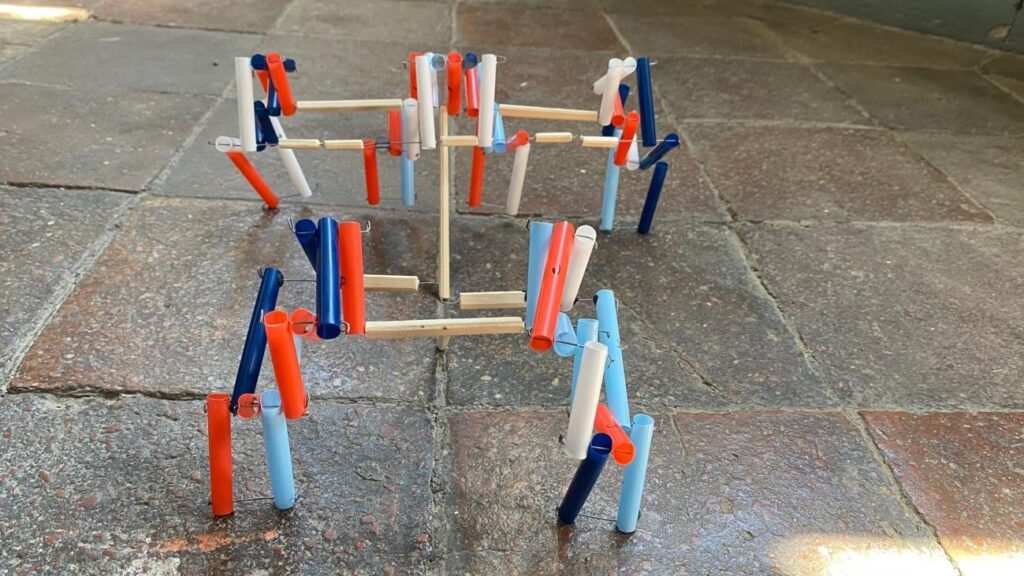
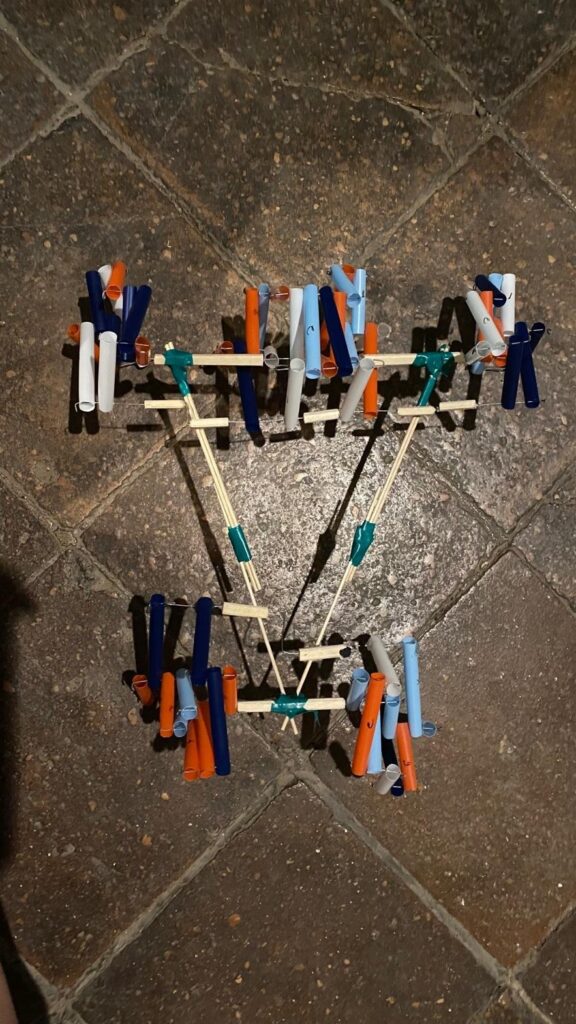
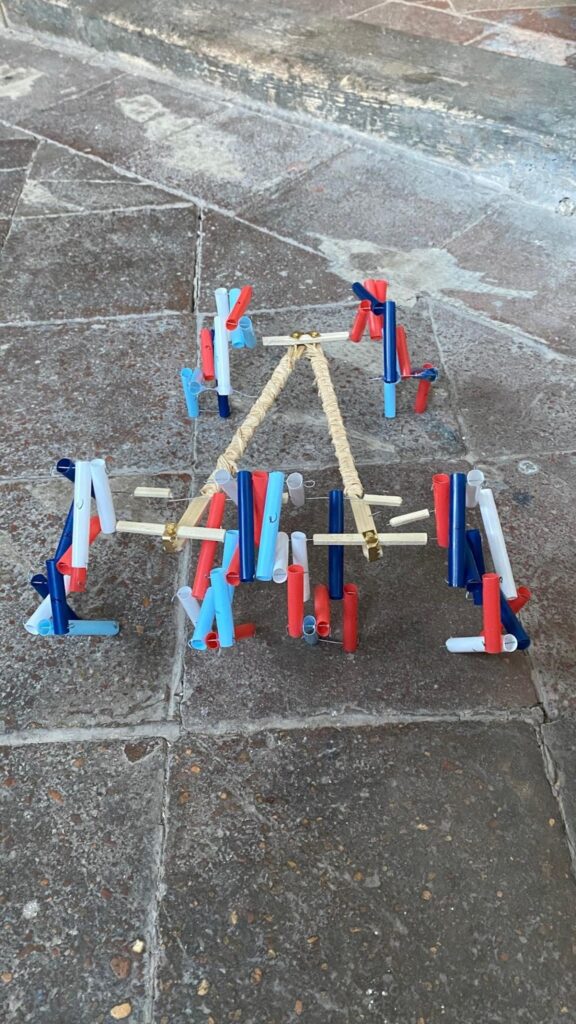
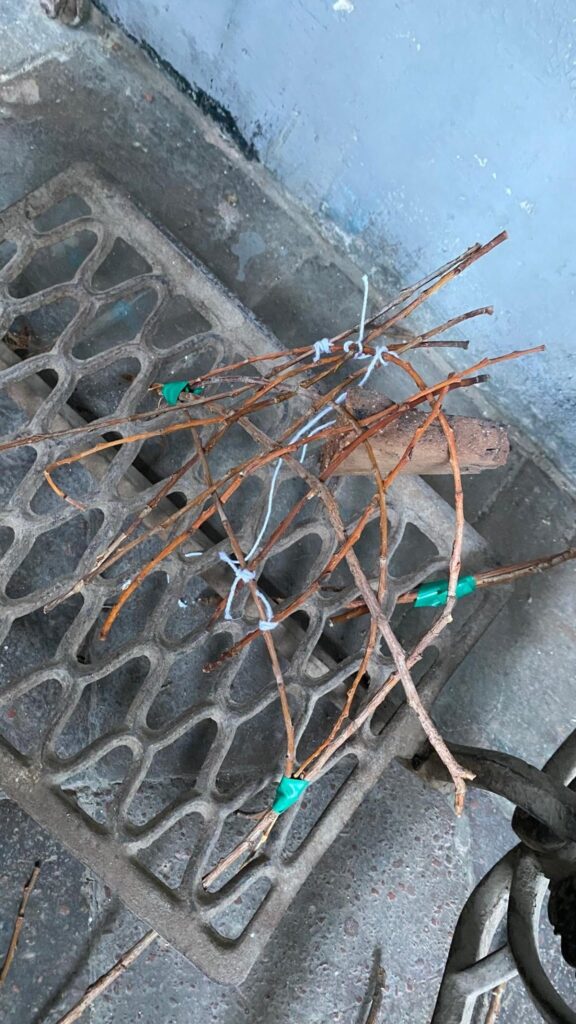
In terms of materials, I had three compositional elements very well identified and defined. First, the wood is non-human, organic and inert, because I wanted to use branches that had already fallen from trees that I could find in the woods. It was the material I intended to use for the puppet's main structure, and it resonated with the importance Street Theatre companies place on building with noble materials. Second, the mechanical and electrical components are non-human technological. These elements would allow Keré to move autonomously and would have to be visible to the audience, since they are not accessories but fundamental parts of Keré’s existence. Finally, the plants are non-human, organic and alive. That element would add another layer of liveness to Keré beyond its overall vibrancy (Bennett).
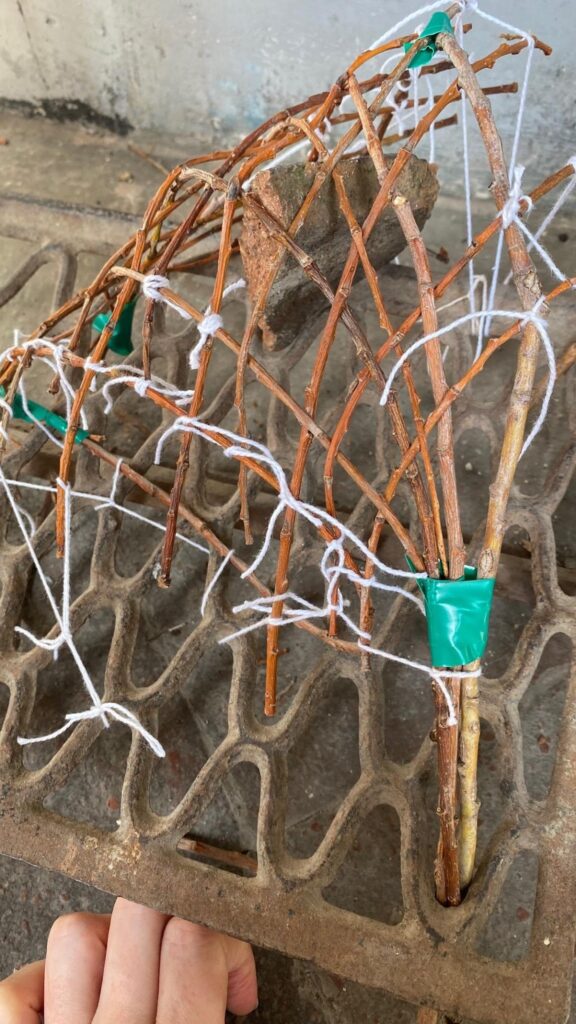
During the first week at Konvent, I combined reading on Iberian culture and language with experimenting with different leg combinations, single and double legs, and placements for Keré’s body. I also tried to make a structure to keep them together and hold the electronic components in the middle. For the second week, I began building a prototype of the dome that would cover Keré, where the plants would be tangled, similar to a vertical garden or the vine coverings commonly found in Mediterranean gardens.
I began exploring potential transmission systems and tested a DC motor with a gearbox powered by an Arduino Uno board. I was able to start the motor, but I could not find a proper system to transmit the energy to the legs. The major problem I encountered was that the plastic straws I used to build the prototype legs could not support the engine's weight.
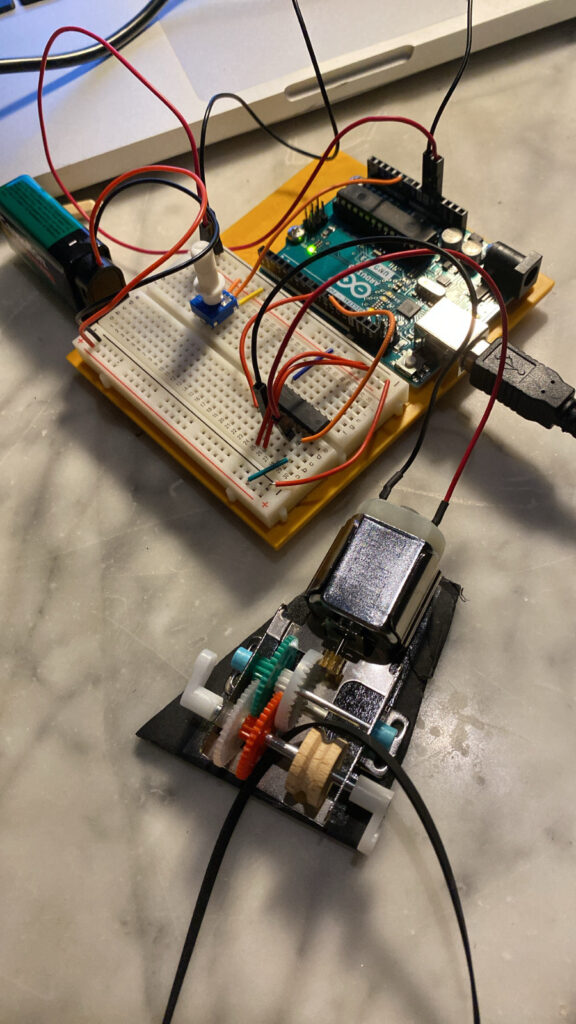
This made me realise that I needed to move forward with building the legs using the final material if I wanted to test any electronics on Keré. Since I did not have the proper tools or the lime tree branches I had planned to use at Konvent, I decided to focus more on reading about Iberian religion and society to lay the groundwork for the performance.
Iberian culture is one of the indigenous proto-Hispanic cultures that was based along the Mediterranean Coast of the Peninsula from around the 7th to the 1st centuries BC. They were in contact with the Greek colonies established along the Northen part of the territory, and other cultures like the Tartessians from Southern Spain, which was a culture that developed after an acculturation process of the indigenous megalithic communities around what is now Sevilla, Cádiz and Huelva by the Phoenician colonies established in the area as early as the 10th century BC (González Reyero & Rueda Galán 22–31). The Iberian language remains unclassified, like Basque, and only certain aspects have been identified, making it still impossible to understand the few inscriptions that have survived to this day. It appears to be an agglutinative language that adds suffixes to change the meaning and syntax of words. The Iberian people were anepigraphic but developed a writing system through the influence of Greek and Phoenician cultures. The writing system was a semi-syllabary, a combination of alphabetical symbols and syllabograms, which were two of the main writing systems in the Ancient Mediterranean. The semi-syllabary seems to derive from the Tartessian writing system, which was based on the Phoenician scripts (Velaza Frías 19–21).
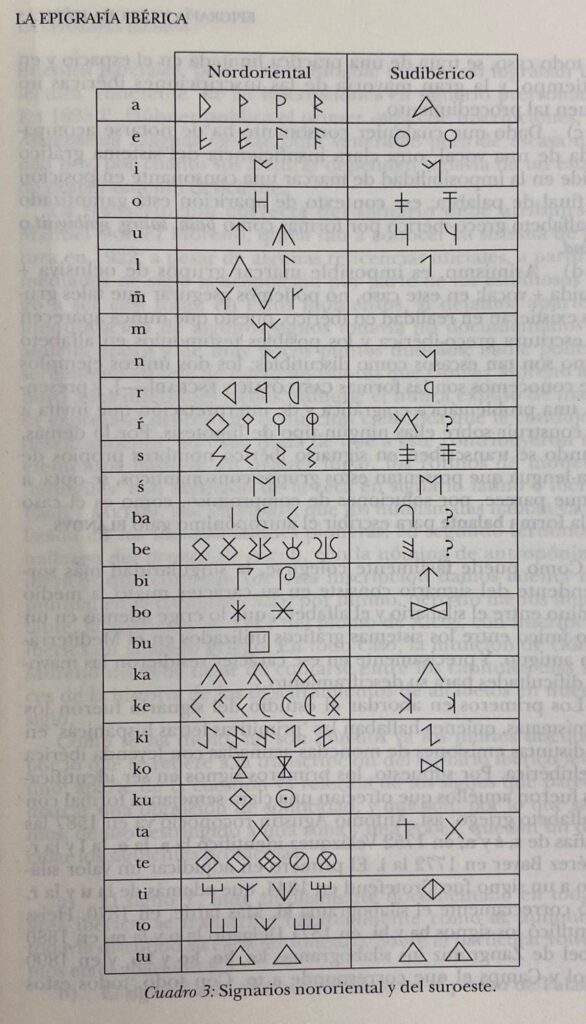
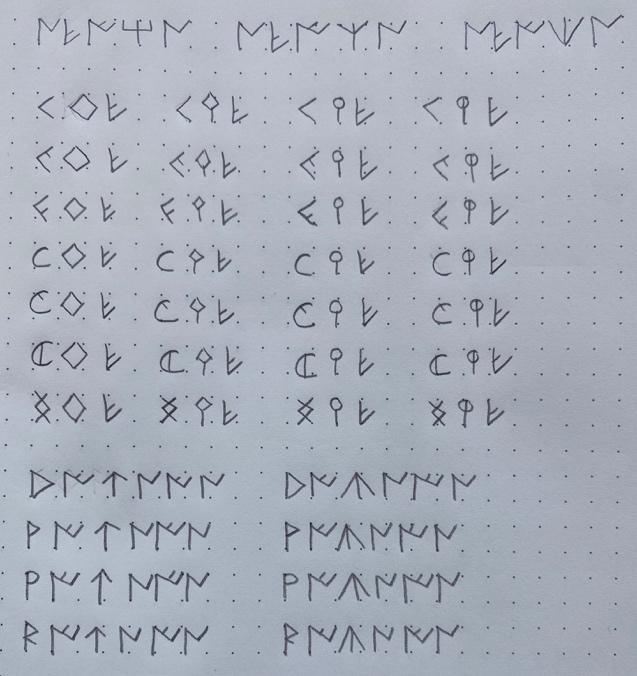
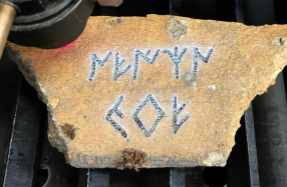
There is some academic consensus regarding the correspondence between the Iberian semi-syllabary and the Latin alphabet. Although it is still impossible to fully understand the meaning of the inscriptions, researchers have been able to identify various personal names and some of their characteristics. I will only describe the three that are most significant for the project. Most names had a bi-member structure, consisting of two-syllable elements that could be interchangeable. Still, there are a few exceptions that feature only one element, such as the name Neitin, one of the most common names found in the Iberian village of Ullastret (Catalonia). They also think that women’s names might keep the same form as men’s names, but they may also add suffixes such as -eton, -aun-, -iaun-, or -in, to signal a woman’s name (Velaza Frías 36–38).With that in mind, I began configuring the performance's name. Ullastret is one of the major Iberian archaeological sites in Catalonia, and it seemed logical to use Neitin as the first element of the performance name, which also featured a feminine suffix mark. In the same pages of Velaza Frías’ book, there was also a list of identified personal names, and I chose Keŕe because I liked how the combination of these two particles sounded together. To avoid confusion in pronunciation while reading the name, I moved the accent to the last /e/ so it would be easier to pronounce for Catalan and Spanish speakers, and it also simplified the typography of the project’s title in the future. Hence, Neitin Keré became the main title of the dissertation and the project, and it also became the names of the two characters in the performance: me (Neitin) and the puppet (Keré).
Another topic I researched was the beliefs and divinity system of Iberian culture. The various cultures of the Peninsula did not leave written records of their beliefs or rituals; most of the existing writings seem to refer to commercial exchanges. What is known about it is through the scarce imagery found, and many questions remain to be answered. As Blázquez comments on his book about religious practices in the Iberian Peninsula, it “[was] a marginal area of the Mediterranean, [where] archaic iconographies that had appeared in all the Mediterranean several centuries before endured” for centuries without many changes (my trans.) (90). The constant contact with the Phoenicians, and later with the Phocaetian Greeks and the Carthaginians, brought divinities and religious practices of the Eastern Mediterranean into the Peninsula. However, the Iberian people did not merely assimilate these elements; instead, they shaped them in accordance with their own belief system. Still, there is a general cult to a fertility divinity represented in the same manner as Astarte, Tanit, or Farnese Artemis along the eastern coast of the Peninsula (Blázquez; González Reyero and Rueda Galán). These female divinities are given different names by different cultures, all representing a great goddess of life who embodies fertility, sexuality, war, and death. It was Inanna for the Sumerians, Ishtar for the Acadians, Astarte for the Phoenicians, Isis for the Egyptians, and Tanit for the Carthaginians (Blázquez 89).
The Iberian people did not adopt sculpture until the arrival of the Greeks, and their sanctuaries were places of cult and prayer dedicated to celestial and chthonian divine elements, rather than sites of worship for a specific anthropomorphic deity. One of the practices they likely assimilated from the original cult to Astarte and Tanit was the use of water for purification and libations during rituals. The latter were not as common on the Peninsula, but some sculptures of women carrying libation vases have been found (Blázquez; González Reyero and Rueda Galán). Agriculture and cattle farming were the main economic activities of the Iberian people, with lentils among the major crops. It was a society closely related to nature’s cycles, which shaped its beliefs and rituals, the rhythm of life and the prosperity of the communities (Blázquez; González Reyero and Rueda Galán 78, 104–36).
WORKS CITED
Bennett, Jane. Vibrant Matter. A Political Ecology of Things. Duke University Press, 2010.
Blázquez, José María. Religiones, Ritos y Creencias Funerarias de La Hispania Prerromana. Biblioteca Nueva, 2001.
González Reyero, Susana, and Carmen Rueda Galán. Imágenes de Los Iberos. Comunicar Sin Palabras En Las Sociedades de La Antigua Iberia. CSIC, 2010.
Velaza Frías, Javier. Epigrafía y Lenguas Ibéricas. Arco Libros, SL, 1996.
1.(Original text in Spanish) “La Península Ibérica es una zona marginal del Mediterráneo. En ella pervivieron iconografías arcaicas que habían aparecido en toda el Mediterráneo varios siglos antes”.
Comments are closed!