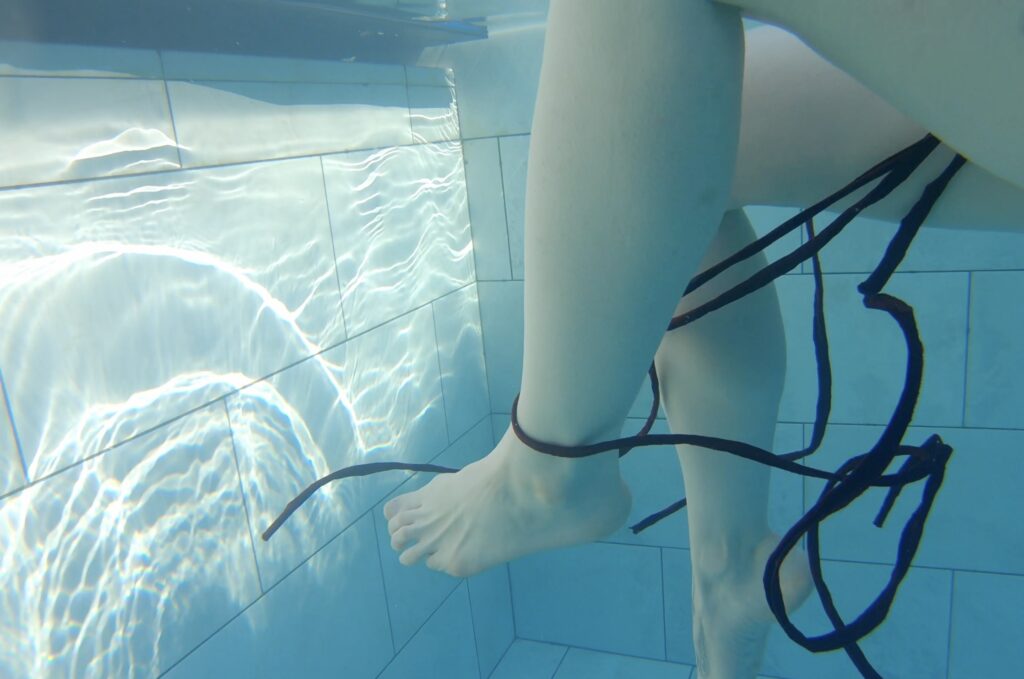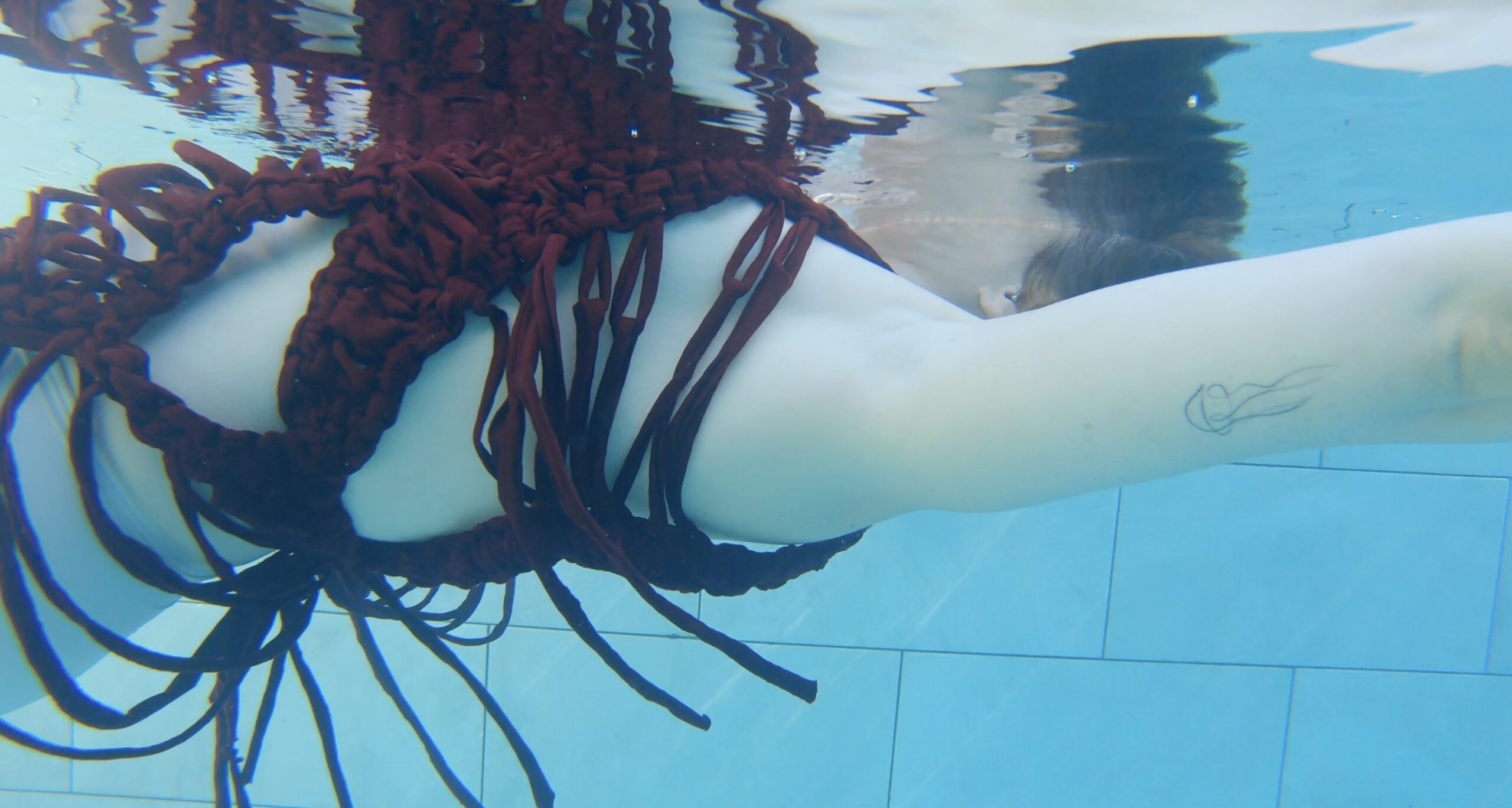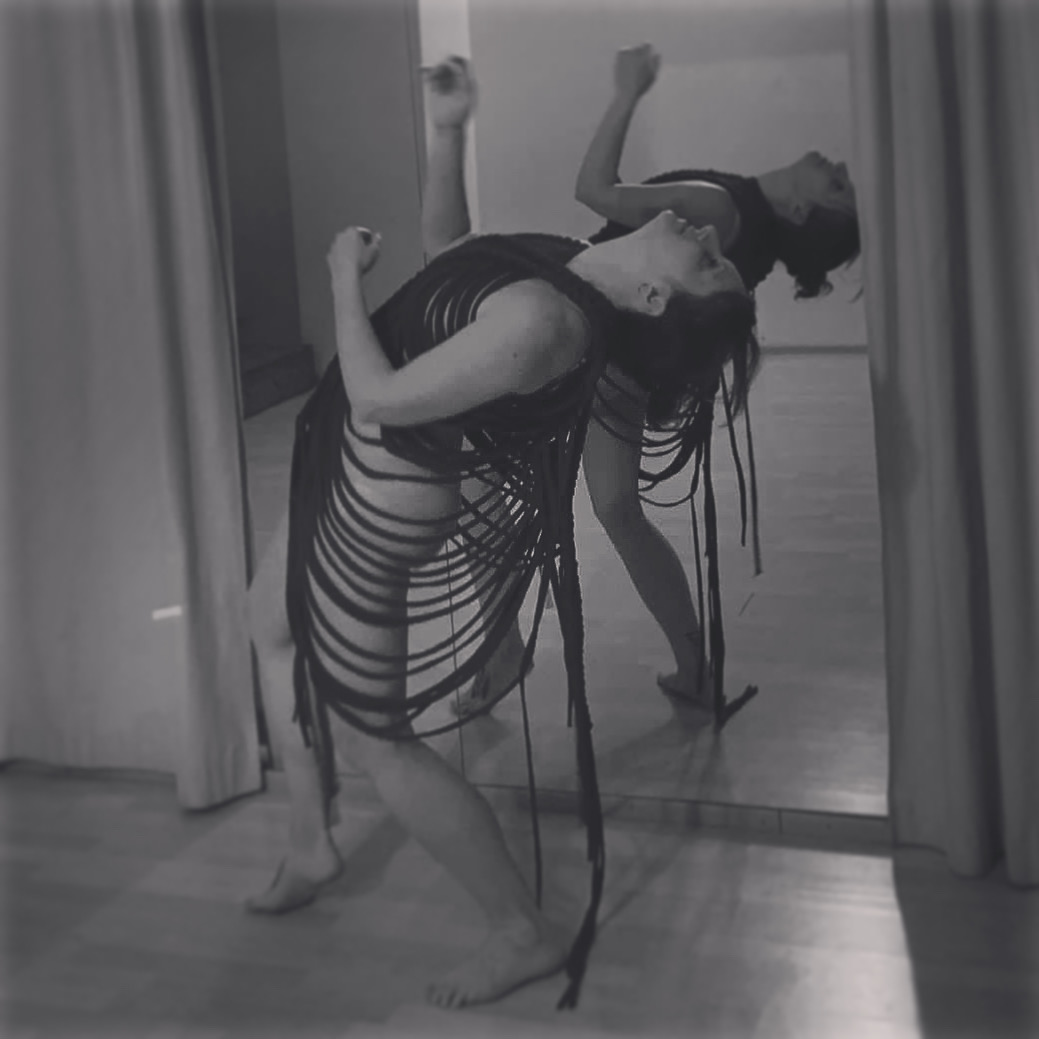

For the performance's costume design, I commissioned Elda de Salas and Andrea Otin, two costume designers recommended to me by Citlali Hernández and Núria Nia. We worked together on the conceptualisation I already had of the religious and female Mediterranean deities. I reinforced the idea that the costume needed to be ecologically friendly and sustainable, and that it had to reflect the intertwinement theme that pervades most parts of this project.
Early on, we chose not to follow a goddess-inspired approach and instead focused on the threading. Elda and Andrea presented some design ideas, and we decided on a costume that was gender-neutral, loose enough to allow movement, and reinforced the idea of intertwinement using the macramé technique.
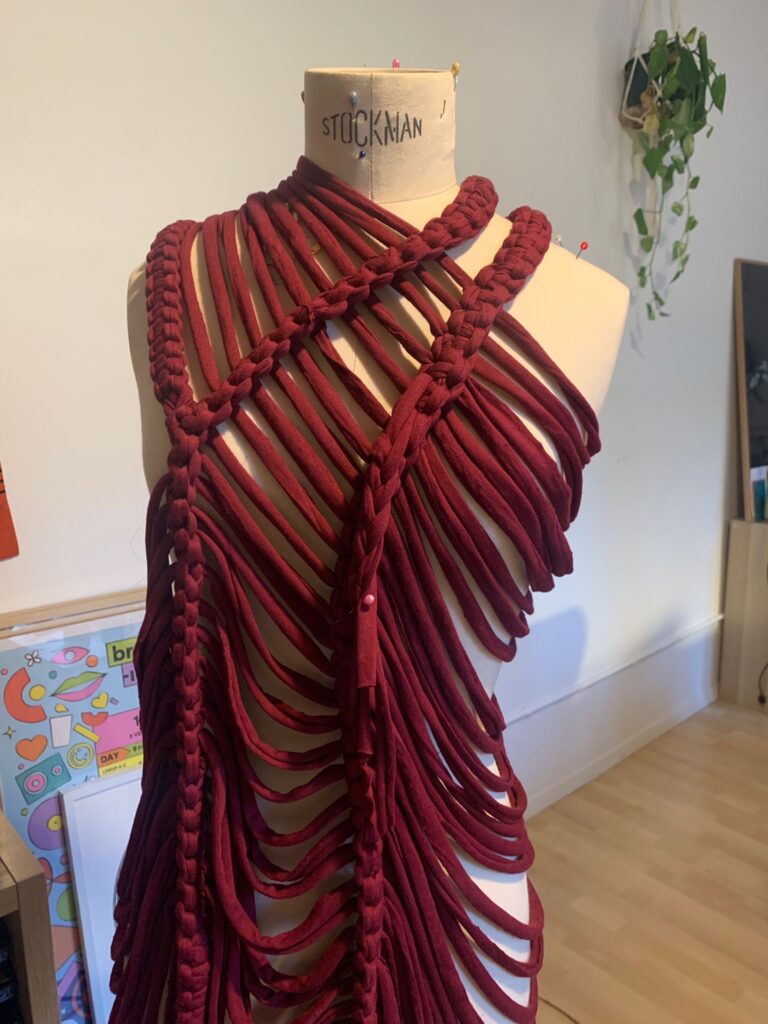
The costume was made using cotton thread in maroon-burgundy colour. It has a couple of structural braids that serve as a spine, holding the dress together, and the rest is covered with a single line of thread that goes around the whole costume, giving it the desired shape.
The narrative arc of the performance follows the idea that ancient religious symbolism. The performance is thought to be like a rite of passage. It is set in an undefined space and time, with minimal action or words taking place. It will be structured, but it will also have a certain element of randomness. Before the audience enters the performance space, they will be given a small glass of wine, with instructions to take a sip or two and then pour the rest into the pile of soil on the ground as a ritual libation.
The set for the performance is divided into two spaces, one for Neitin and another for Keré. Although we share the same physical space, there is no bodily contact between the two of us. Our interaction is based on sound and movement: the sound Keré produces while moving affects the overall sonic ambience, and my sound affects Keré’s behaviour, but I am very careful not to create a power dynamic in which the puppet must follow my orders. It will be a subtler reaction that modifies Keré’s movement pattern, but in a way that is not too obvious. Since Keré is programmed with a random movement pattern, I cannot know in advance what its next move will be or how it will react to my sound interactions.
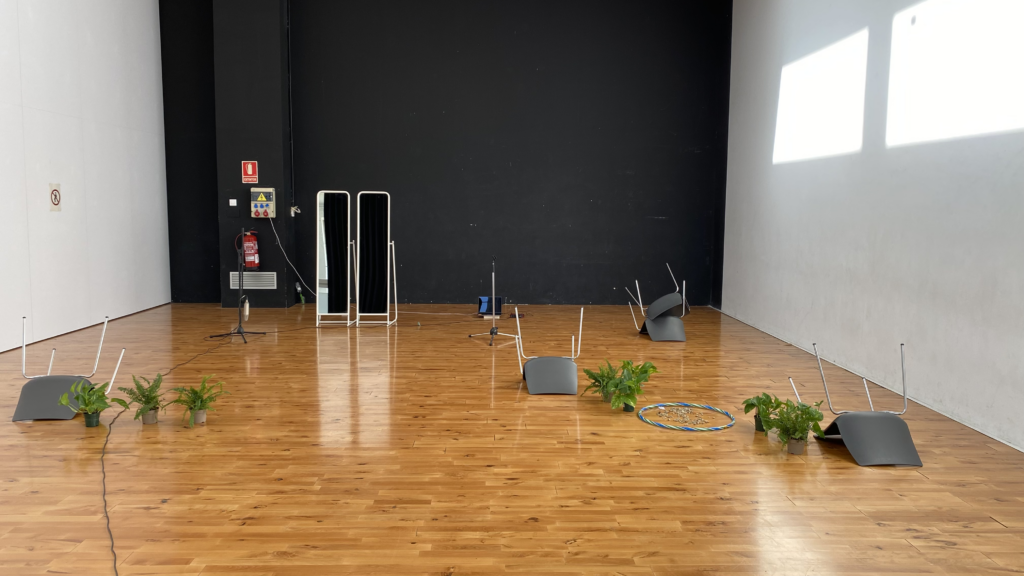
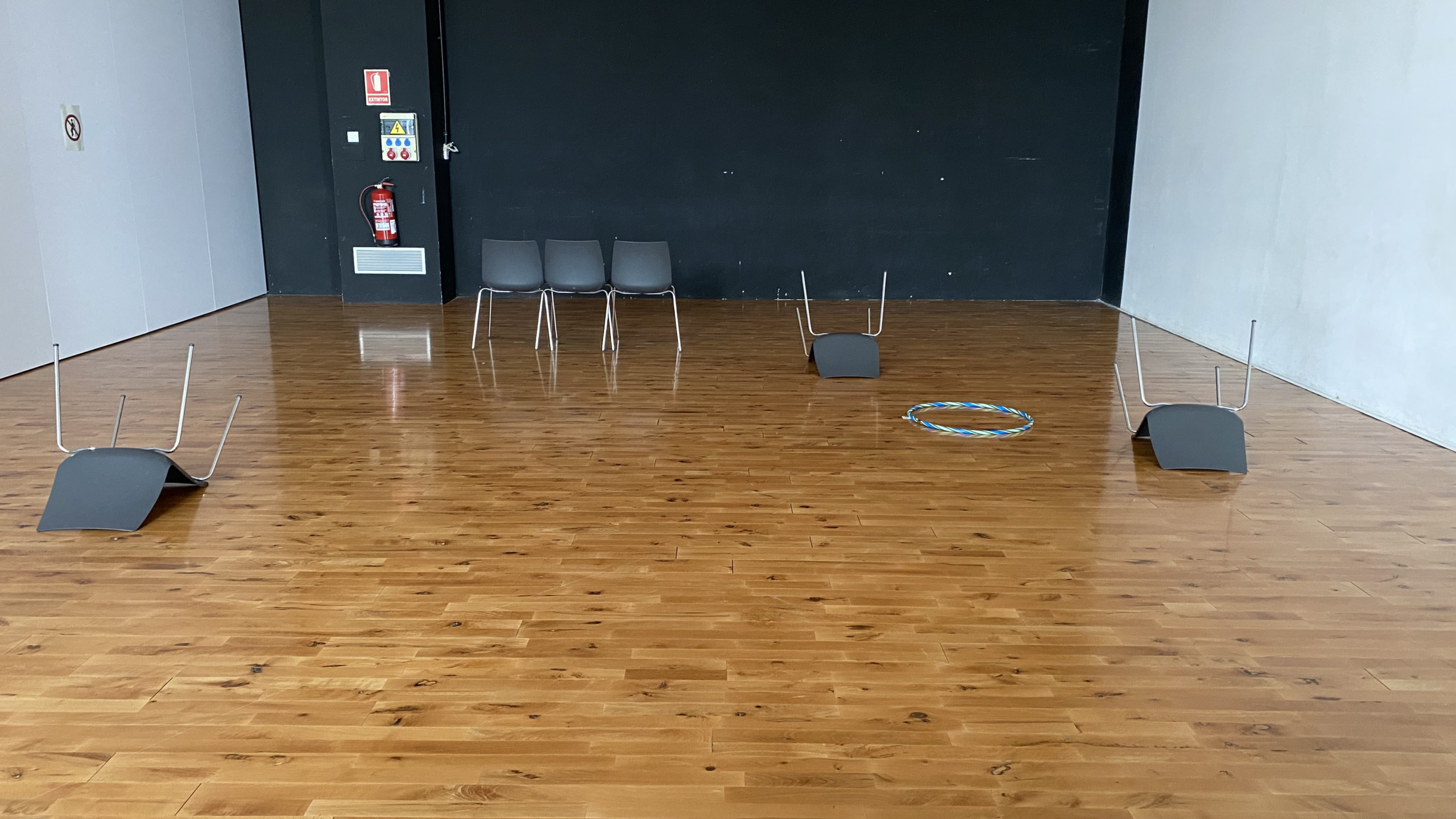
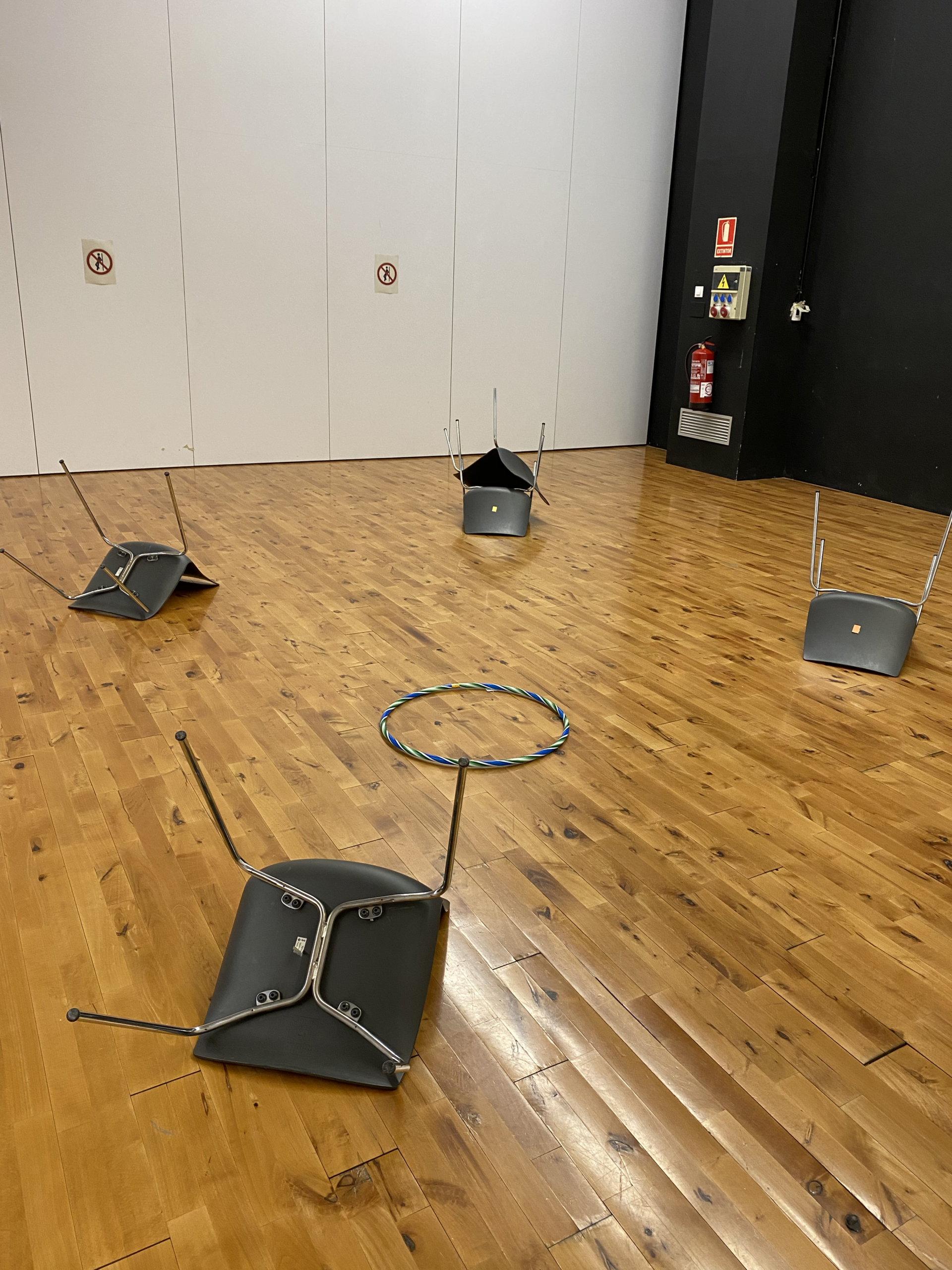
In the picture, a possible setting for the performance is shown. The chairs and mirrors will serve as screens; Keré will be placed where the circle is located, on top of gravel, and surrounded by soil and Mediterranean plants. My performance space will be on the other side of the stage, where some mics and possibly a live camera will also be. The mics will be used to capture some of the live sound ambience, along with vocal loops and sound effects.
Apart from the technology integrated into Keré’s body, our two bodies are displayed in the performance both physically and digitally through video projections. Most of these projections are pre-recorded, but they are combined with live video feeds from a camera placed in Neitin’s space and from a camera within Keré’s body that captures its perspective. In this way, my human interaction with the technology present in the performance remains external to my own body, yet together we co-create a narrative, allowing for different points of view and understandings of the bodies and spaces involved. The video projections will occur simultaneously on several modified computer screens positioned around the set.
Once the costume was ready, I was able to shoot some images of Neitin in the water. My first idea was to shoot mainly in natural environments, like rivers and the beach, but I decided that creating contrast with more urban or industrial images would be more interesting and add tension to the dramaturgy of the performance. Since Keré is still not in its final form, I have not been able to shoot any videos with it, but that will also be part of the performance's audiovisual environment.