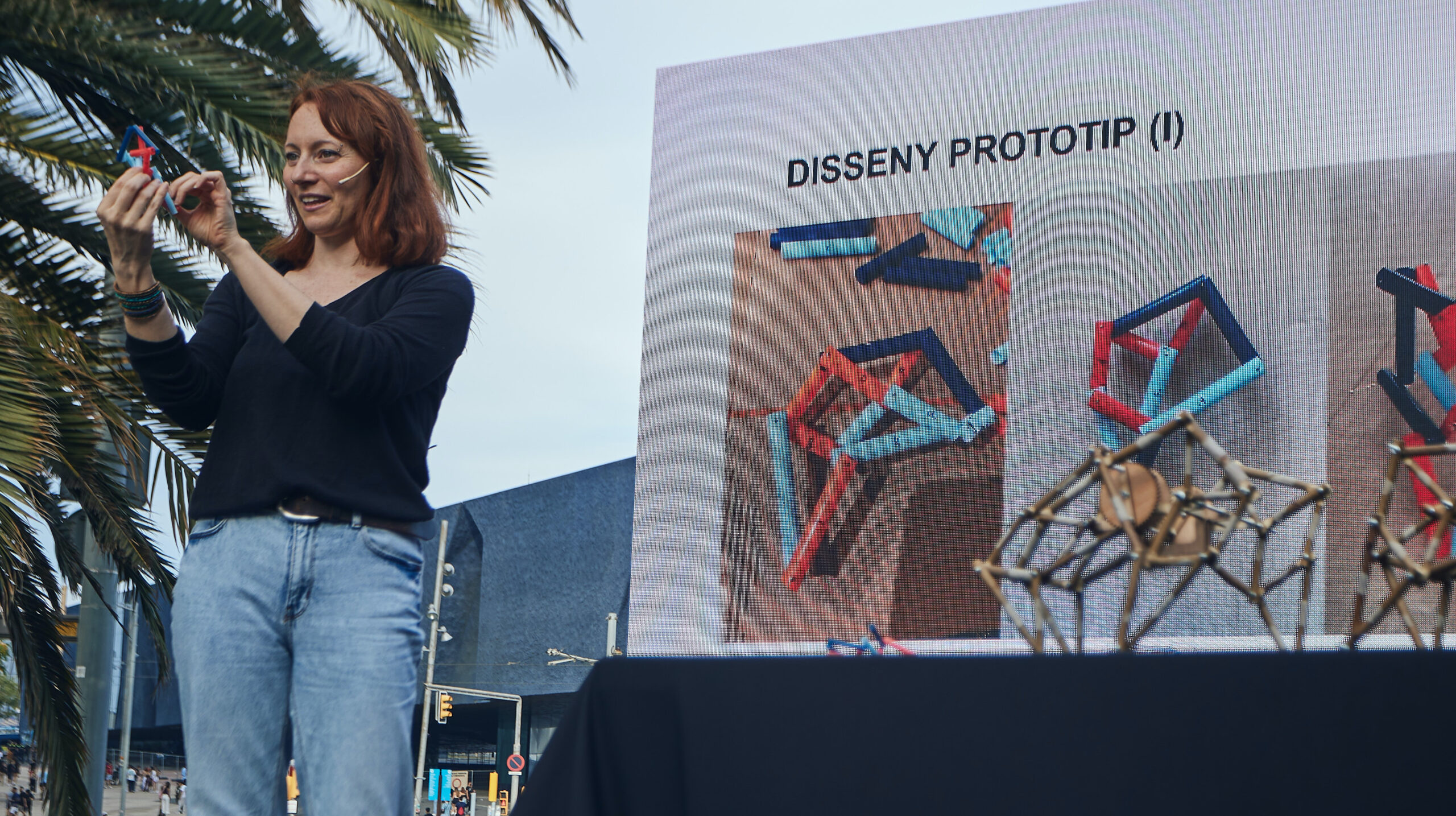

A few months after my stay at Konvent.zero, I started my artistic residency at Fabra i Coats, which took place from February to June 2023. I used all the research on the Iberian people to begin developing the performance.

Initially, I began improvising with movement, using Laban’s Movement Qualities as a guiding tool to explore. My first concern was finding ways to relate to Keré through movement without imposing my actions on the puppet. Drawing inspiration from Keré’s polygonal leg shape, I explored different ways of walking and moving around the space that could recall Keré’s embodied structure.
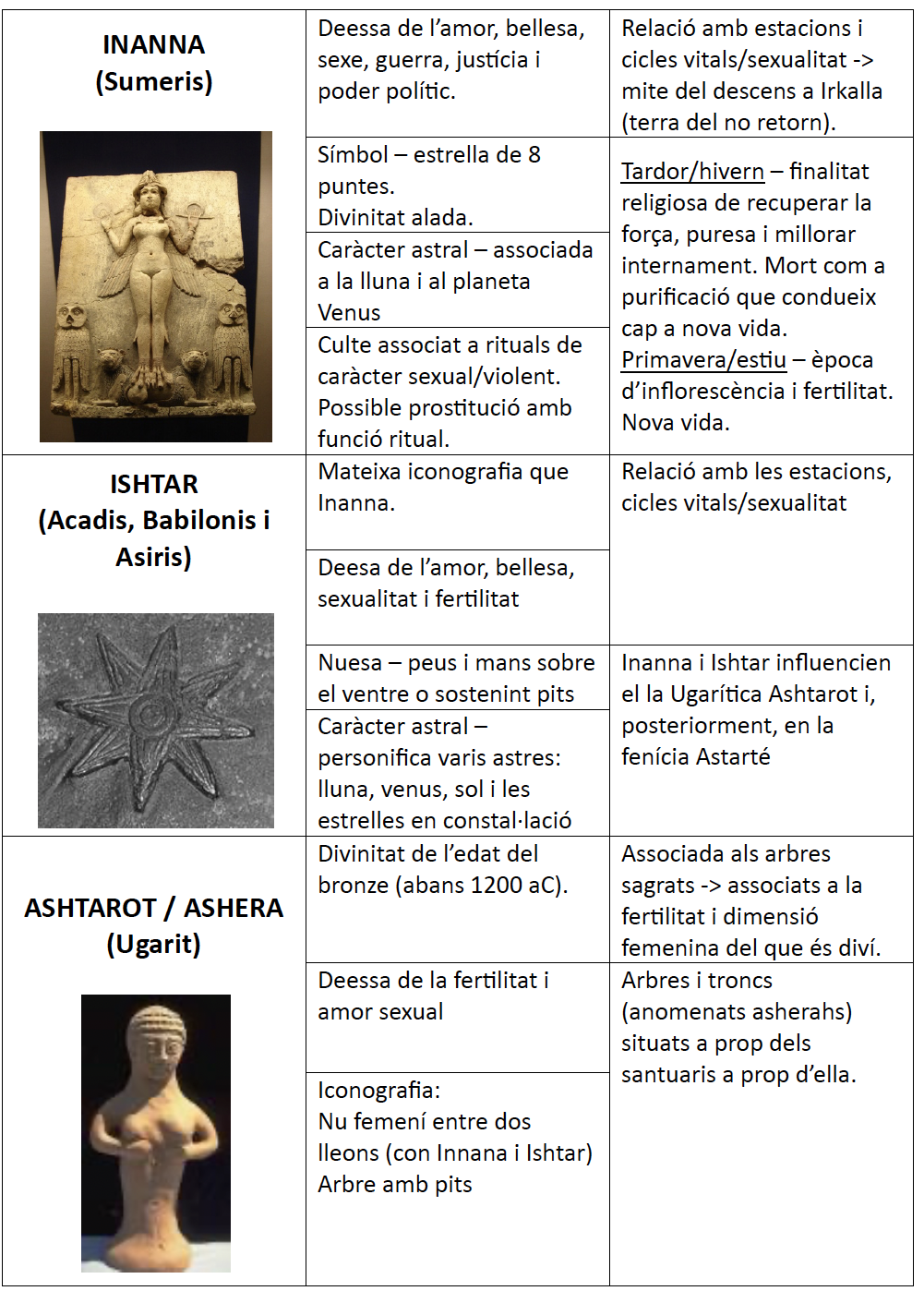
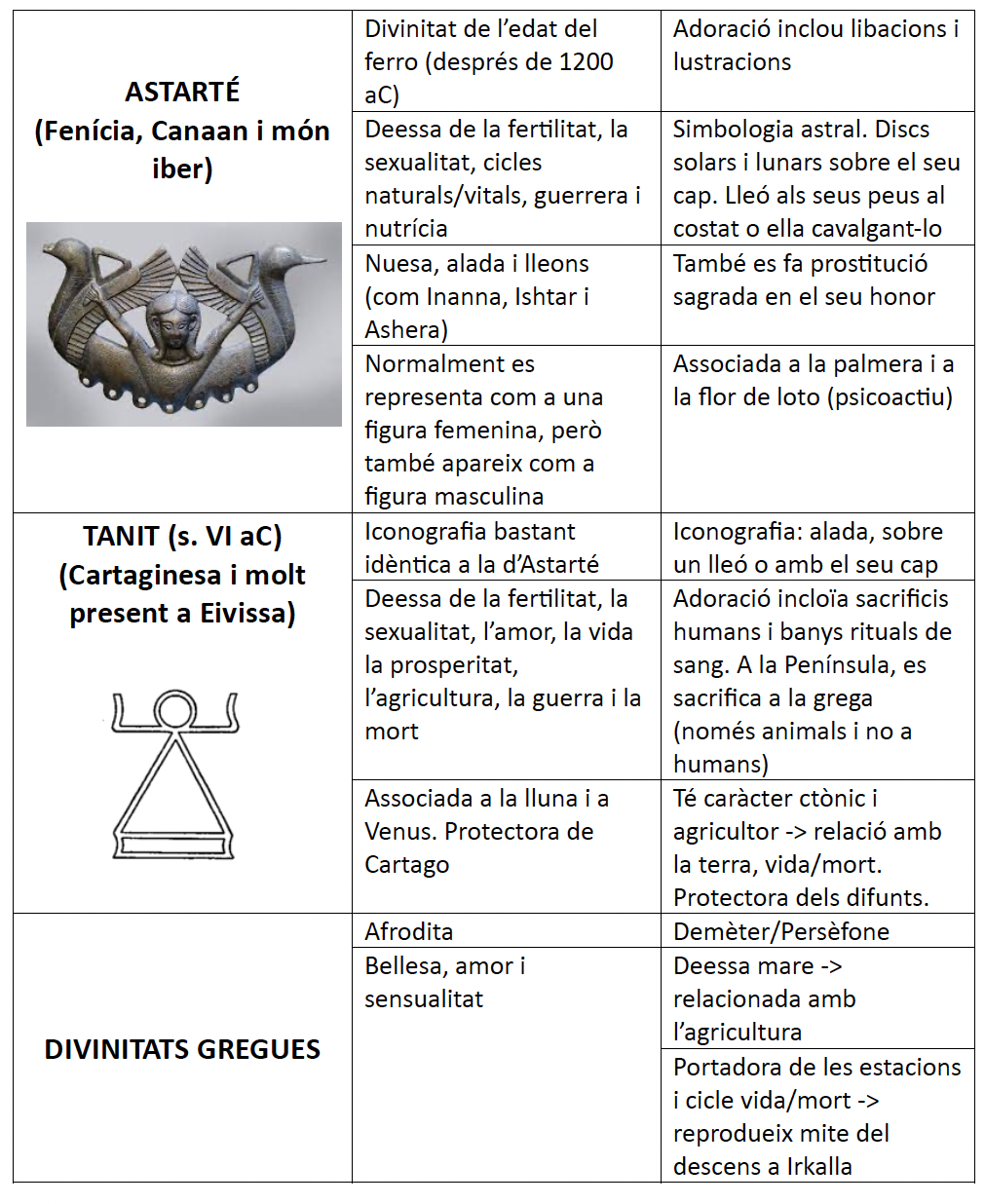
However, I soon decided to explore how to integrate my knowledge of Iberian religion into the performance and my movement. Since the main female divinities in the Iberian belief system were of Middle Eastern origin, I started checking their attributes, rituals, and iconography. I realised there were many similarities among them, but what interested me most was how the different iconographies could be transformed into a movement sequence that could serve as a model for most of the performance.
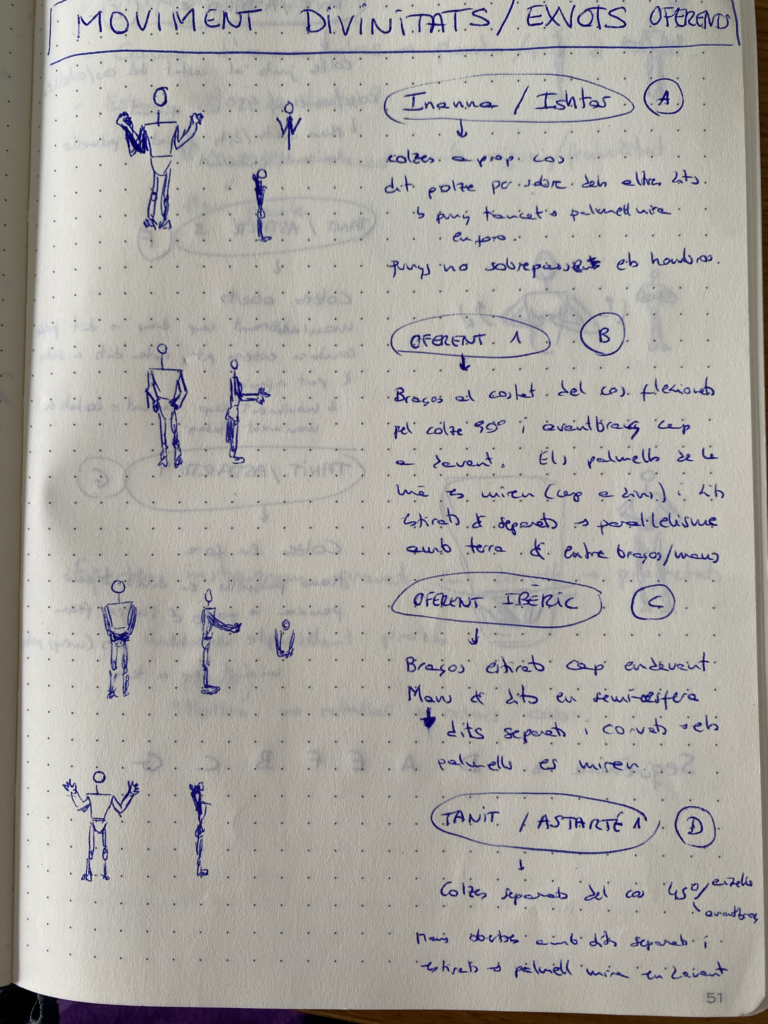
I worked on the sequence using José Sanchís Sinisterra’s Repetitive Minimal Systems model (Sanchís Sinisterra), first isolating each movement, then creating a movement sequence, and later adding variations of time and space to this system.
Iconography movement sequence
The research on the Iberian belief system also influenced other aspects of the performance, including the definition and characteristics of the two main characters, the sound ambience, the set, and the overall arc. Neitin, the human element, is water-related — not in the sense of using water for purification, but to create sound atmospheres. My movements tend to be more repetitive and sinuous, and most of the videos associated with Neitin are shot near water.
Keré, on the other hand, is plant-related. Its space is surrounded by soil and edible plants, but most importantly, its embodiment is plant-related. It is made from lime wood branches, with a vegetable covering where lentil sprouts grow — one of the main crops cultivated by the Iberian people.
Contemporary with Iberian culture in the north-western part of the Peninsula were Celtic peoples whose culture was similar to that of other northern European Celts. For them, the tree symbolises “not only the support of the universe, but the limit between life and death (…) tying both worlds together”(1) (my trans.) (Blázquez 190). Consequently, using this tree metaphor also supports my argument that Keré is a non-human element with agency that is both organic and inorganic, organic and technological, and inert and alive at the same time.
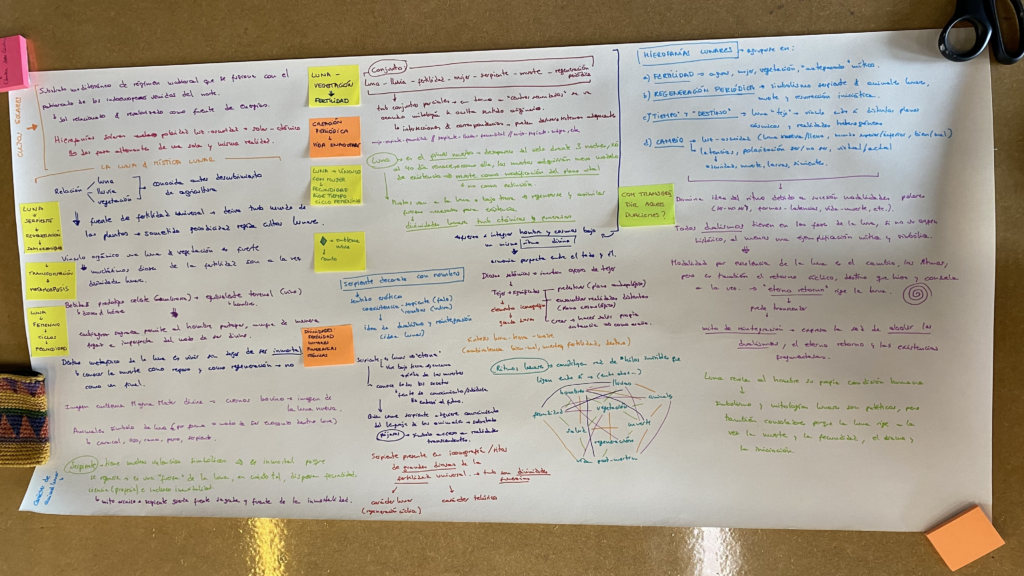
Following this character definition, I continued researching the symbolism of plants and water in ancient belief systems using Mircea Eliade’s book Treatise on the History of Religions. Even though he is a problematic author because of his political beliefs, he offers a broad symbolic vision that was useful for further conceptualising the performance.
Another aspect I experimented with during those months was the sound ambience. I warmed up by creating vocal loops that I could dance with and improvise. But once I had a clearer definition of the attributes of the characters, I moved into trying to research possibilities for generating water-related sounds for Neitin, and soil-related sounds for Keré. I wanted Keré to walk on soil or pebbles so its movement would have more friction, but at the same time, to use the sound to co-construct the sound ambience together. What worked better were very small pebbles that would not interfere with Keré’s movement and produced a sound closer to what I was looking for. Since Keré was still unable to walk at the time, I focused my experimentation on water-related sounds and ambience.
To start focusing on water sounds, I wanted to capture the sound of a water drop live to create the sensation of being in a cave, which were places of worship for the Iberian people on the Eastern coast of the Peninsula. To achieve this, I explored various water-dripping devices, microphone types(2), and containers for holding water.
Testing water sounds
I was not able to get the proper drop sound I was looking for during the trials at Fabra i Coats, but months later, while cooking in the kitchen, I realised that water dripping onto a metallic surface and then letting the drops slide into the water container produces the sound I was looking for.
My final iteration, exploring with water, tried to bring together all the elements I had been working on: sound loops, water ambience sounds, and movement, creating new preliminary choreographic ideas for the final performance. Something I also started exploring was editing the movement videos with Instagram filters. For the final performance, I will use TouchDesigner or another open-source software that allows me to modify the texture of live-feed videos.
Final iteration bringing all the elements together
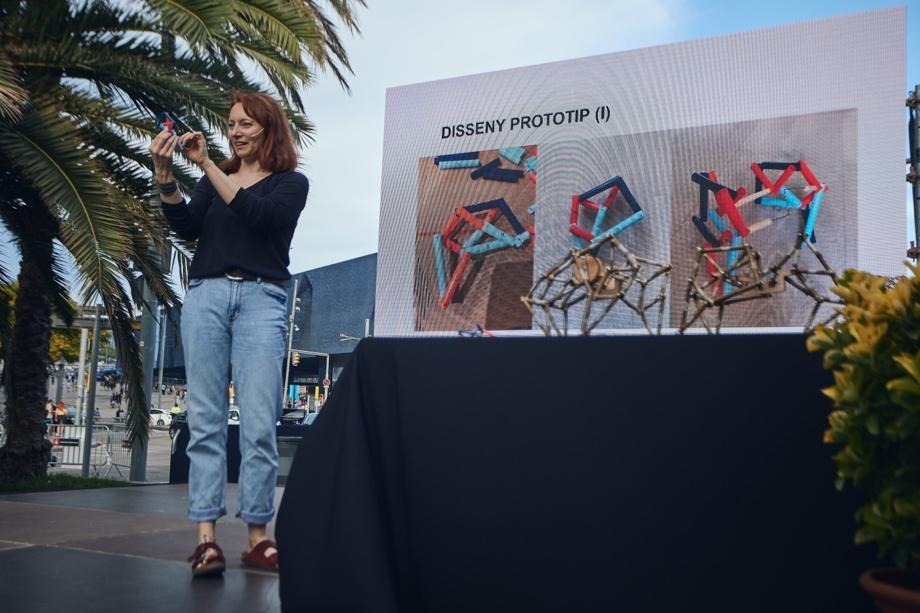
In parallel with my artistic residency, the managerial team at Fabra i Coats works to create connections between resident artists and other cultural and educational infrastructures. Since it is the only Creation Factory managed directly by the Barcelona municipal government, it is in direct contact with the municipality's education and culture departments. Through one of these meetings, my project was proposed to be presented at the 16th Festa de la Ciència, a yearly science festival organised by the Department of Science and Innovation of the municipality to promote interactions between citizens and families and researchers based in the city, who can present their work in an interactive way for a broader audience (Ajuntament de Barcelona, ‘Festa de La Ciència’). I gave a short talk about the project titled "Interrelations between Performance, Art, and Science," presenting the broad context of my research and Keré as it stood on the 10th of June 2023.
WORKS CITED
Ajuntament de Barcelona. “Una Festa per Descobrir, Experimentar i Viure La Ciència | Festa de La Ciència.” Ajuntament de Barcelona, 2025, https://www.barcelona.cat/festa-de-la-ciencia/ca/una-festa-descobrir-experimentar-i-viure-la-ciencia.
Blázquez, José María. Religiones, Ritos y Creencias Funerarias de La Hispania Prerromana. Biblioteca Nueva, 2001.
Eliade, Mircea. Tratado de Historia de las Religiones. Morfología y dialéctica de lo sagrado. Ediciones Cristiandad, 2009
Sanchís Sinisterra, José. “Sistemas Minimalistas Repetitivos (SMR) - Nuevo Teatro Fronterizo.” Nuevo Teatro Fronterizo, 2010, https://nuevoteatrofronterizo.es/campo-de-ideas/smr/.
(1) (Original text in Spanish) “[El árbol] no solo es el sostén del universo, sino el límite de la vida y la muerte[,] (…) enlaza los dos mundos”
(2) For all the sound experimentation I used the following microphones: Rode NT1000 (studio vocal condenser microphone), AKG C411 PP (condenser contact microphone), Shure Beta 58A (vocal dynamic microphone). To generate the loops and sound effects I used the TC Helicon VoiceLive Touch2. As an audio interface to connect to my computer and record the sounds I used the Focusrite Scarlett 2i2. To reproduce the sounds live, I used the sound boards and PA system provided by Fabra i Coats in their rehearsal spaces.