
When I first started thinking about the practice and how it would relate to the rest of the PhD, I had set the structure of the dissertation in relation to the practices of the different companies, which were classified according to the type of technologies they used – mechanical and robotics, digital and intermedia, and cyborgean and biohacking techniques. I expected to do a small piece of practice for each chapter, which soon proved to be too ambitious an idea. Still, I started thinking about a practice I could carry out using the information I had collected from interviews with companies that worked in Street Arts and primarily used mechanical technology.
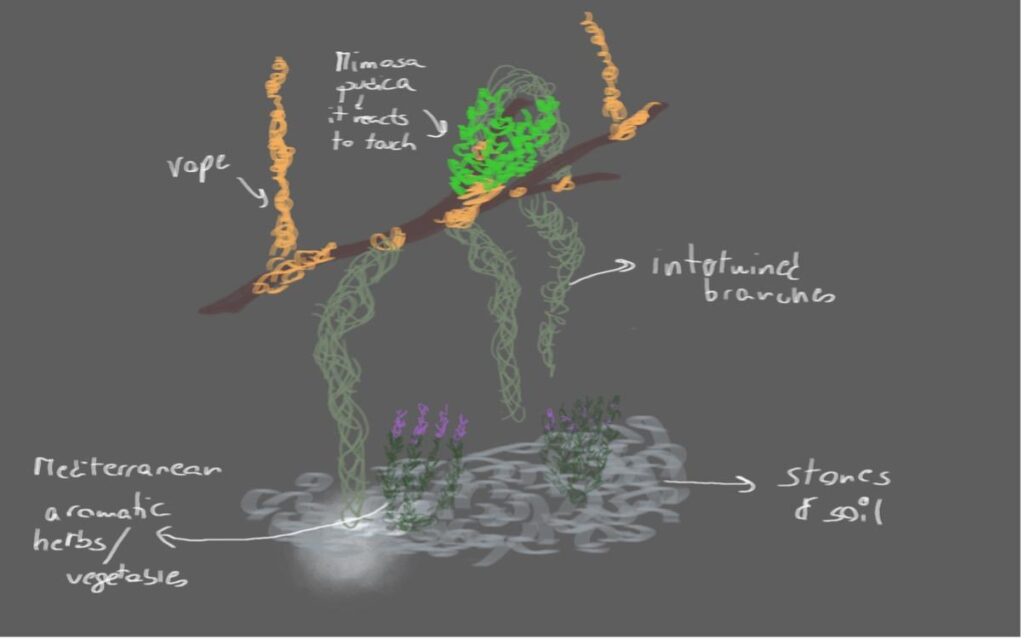
Those companies placed a strong emphasis on the nobility of the materials used and on making the technology visible and understandable to the audience. Hence, I started thinking about how I could create a puppet with a movement mechanism but no figurative shape, using mostly organic found materials. I collected small branches while walking in parks and the mountains around Barcelona and Amsterdam. For a couple of months, I tried to find a larger branch that would suit the body of the puppet, but I was unable to find any properly sized branches – they were either too big and heavy or too small.
The idea of using a branch also raised different concerns – how could I hold the branch standing so it could move? I would probably need a support structure – even if I added “legs” to the branch – that was robust enough to hold the weight of the branch and the other mechanisms. But setting the puppet on a support structure reduced its mobility and autonomy, and complicated transporting the performance if I had to bring it to London at some point. I sketched some ideas for the support structure and for the performance space using the branch. It looked more like an installation, and it was clear that our interaction would be limited and complicated. With these in mind, I started searching for other ideas to make the puppet more autonomous.
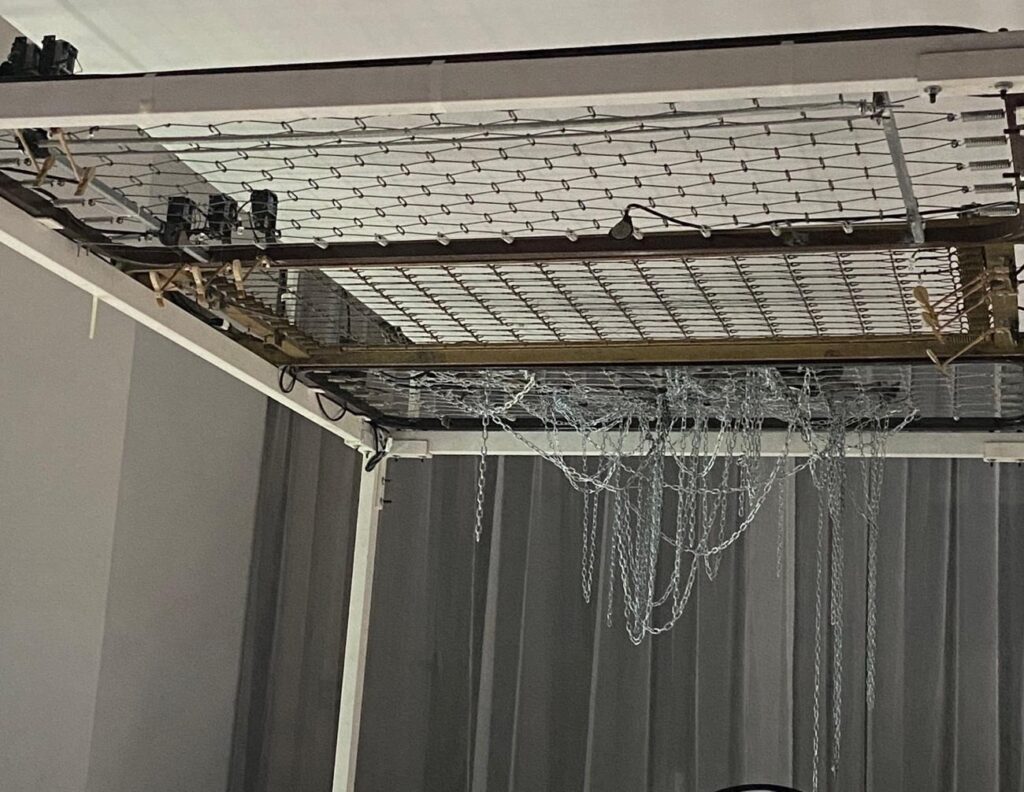
I had taken some ideas on how to support the branch from the hanging mattress structure showcased at the centre of the performance space in Dimonis (2019) from Cabosanroque. It was a metallic frame that held the mattress on top and had metallic chains that held various everyday objects, producing sounds when a mechanism made the structure shake. But all in all, the whole idea seemed too sturdy and heavy for easy transportation.
In January 2021, talking to some fellow circus performers and dancers about what we were working on, a colleague who works in acrobatics showed me some videos of a project where he had built a set of two legs of Theo Jansen’s Strandbeest walking mechanisms on stilts to recreate a Minotaur character and suggested it could be an option to make my puppet move more independently. He also commented that the specifications for the walking mechanism were available online as open source. The next morning, I looked into the information available on Theo Jansen’s website and started experimenting with building a leg using materials I had at home – at first, I used plastic straws and head pins.
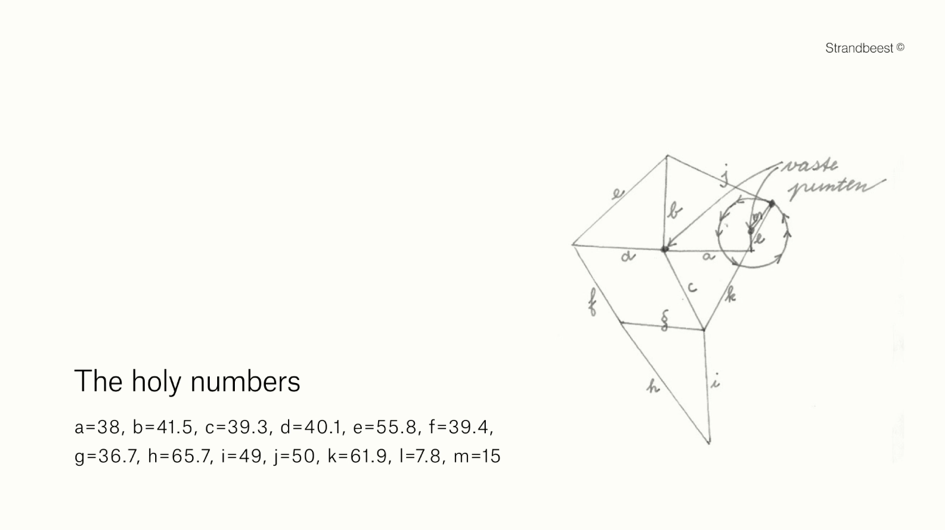
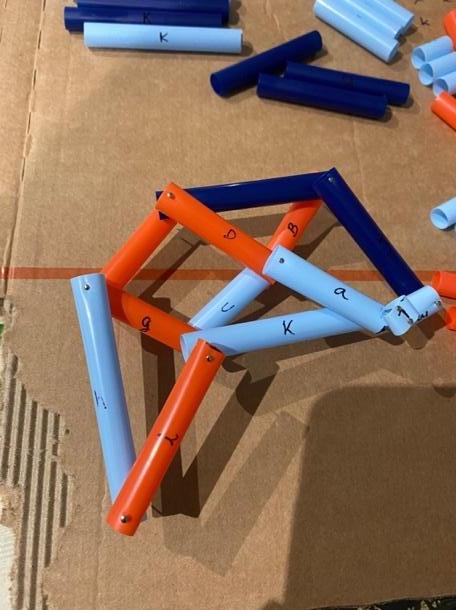
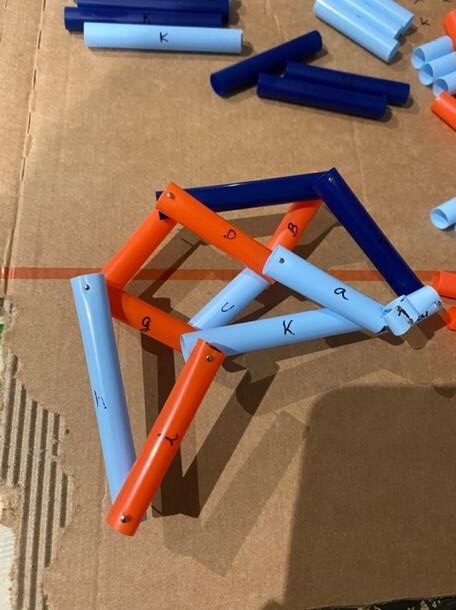
In these first attempts, I misinterpreted Jansen’s diagram and added a couple more pieces to the leg that were meant to represent distance measurements. I corrected these in subsequent trials and realised that the pieces forming the legs had to be layered strategically to achieve smoother movement. Once I had a more consistent layering, I started using thin wire instead of head pins because I could cut it to the needed length, and it allowed me to secure both ends of the junctions so the pieces would not fall apart. Also, the holy numbers – as Jansen calls the measurements for each leg piece – available on his website were for much larger pieces. I was working on a much smaller scale, and I had to compromise on the measurements of some pieces since I could not be two-decimal-precise when cutting them with a box cutter.
Once I had a leg that worked and was correctly layered, I built another one facing the other direction so I could have what I had decided were the external parts of each leg on the outside of the mechanism. Thereafter, I started looking at how to put those two legs together and which transmission mechanism could enable them to move alternately. I decided to try to recreate a crankshaft using thicker wire and pieces of chopsticks. From the beginning, it was important to me to (re)use materials I had available at home to be as sustainable as possible, although I was aware that single-use plastic straws are not the most eco-friendly option. Still, I tried to buy as few new materials as possible.
Beyond this preliminary puppet design, I bought an Arduino kit and some basic sensors, and I trained with it by working on simple projects. I decided to use a motor that is activated by a sensor, possibly a proximity or light sensor, to make the puppet move. I do not have much training in coding and programming, and I will need help from someone more experienced with the actual building, but I believe it was important to test and understand the product's basic capabilities to better refine and communicate my ideas. In addition, this is part of my argument: to empower artists to research and develop in technical fields beyond their usual medium.
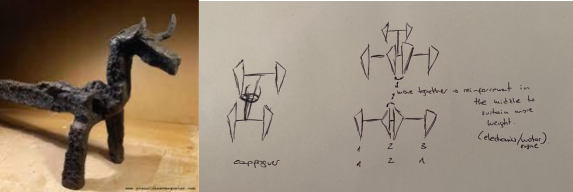
At the same time, I was trying to figure out how to set up a functional crankshaft between the two legs. I also focused on what the possible final shape of the puppet could be and what sort of alternate movement the legs could have. From the beginning, I did not want the puppet to resemble an insect, or at least not a very distinguishable one. Since I was intentionally basing the main dramaturgy of the project on Iberian culture, I took the image of an Iberian Capfoguer, a metal firedog found at the archaeological site of my hometown, shaped like a bull. Even though bulls were a symbol of fertility in the Ancient Mediterranean, for me, it is problematic to use this image for what it entails within Spanish culture. Consequently, I took some ideas for the arrangement of the legs but avoided making the puppet look like a bull.
Using Iberian Culture as a dramaturgical thread in the performance was not a random choice. Many proposals from the artists studied and beyond have taken Ancient Mediterranean cultures and mythologies as the narrative starting point for some of their works. Beyond that, I have always been drawn to Ancient History. I specialised in the Ancient and Medieval World in my BA in Humanities, and there is an Iberian archaeological site in my hometown that is where I go when I need to calm down and think. Hence, it made sense to see where this thread could lead me. The Iberians had an alphabet that derived from the Phoenician alphabet. Although there is an agreement on what letters and syllables each symbol represents, the Iberian language has yet to be deciphered. The Iberians were not a culture interested in transmitting their myths and knowledge through writing. Most of the written pieces found depict commercial transactions.
One of the few things that seems to be deciphered from the language is that people’s names had a bimember structure, which is why the project is called Neitin Keré, two common names found at the archaeological site of Ulldecona (Catalonia). You can find more information here.
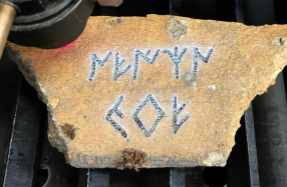
Consequently, everything known about their religious practices and beliefs must be inferred from the decorations on pottery and liturgical objects. What is known is that there was one major feminine divinity recalling Astarte, the Phoenician divinity of sex, war, royal power, and beauty. The cult of Astarte derived from a very ancient Semitic cult of Innana/Ishtar, goddesses with similar powers who were also fertility deities. Around different Ancient Mediterranean cultures, many divinities with the same archetype and similar iconographies can be found. For example, another major divinity in the Balearic Islands was the Punic Tanit, which has the same iconography as Astarte, or in Greek mythology, with Demeter and Aphrodite. Learning about this switched the topic of the dramaturgy from Iberian culture to Ancient Mediterranean divinity archetypes and symbolism.
During the artistic residency at Konvent.zero I decided what the final shape of the puppet could be using the plastic straw prototype, worked on a possible transmission system with an engine I had available, and built a dome made from found branches that could hold the plants on top of the puppet. The chassis structure was too weak to hold everything together or to add an engine, but it helped me get an idea of what would be necessary to make the puppet a feasible project.
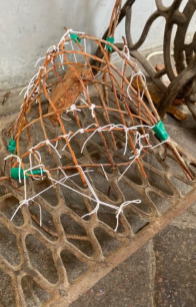
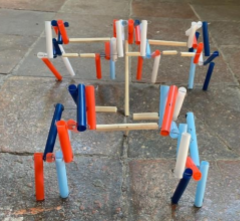
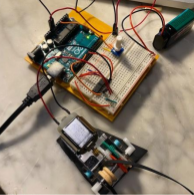
The dome, the final shape for the structure and the engine testing.