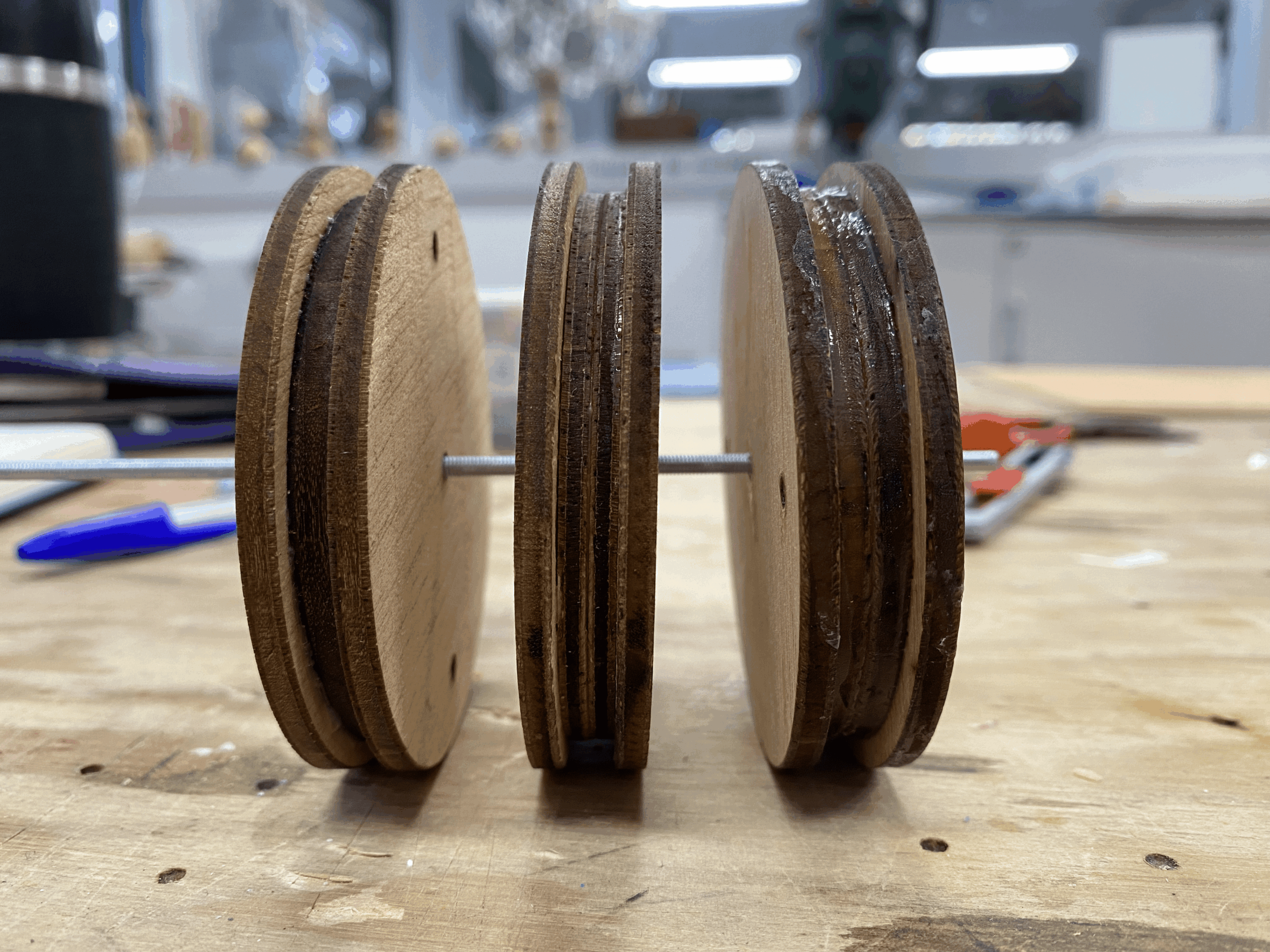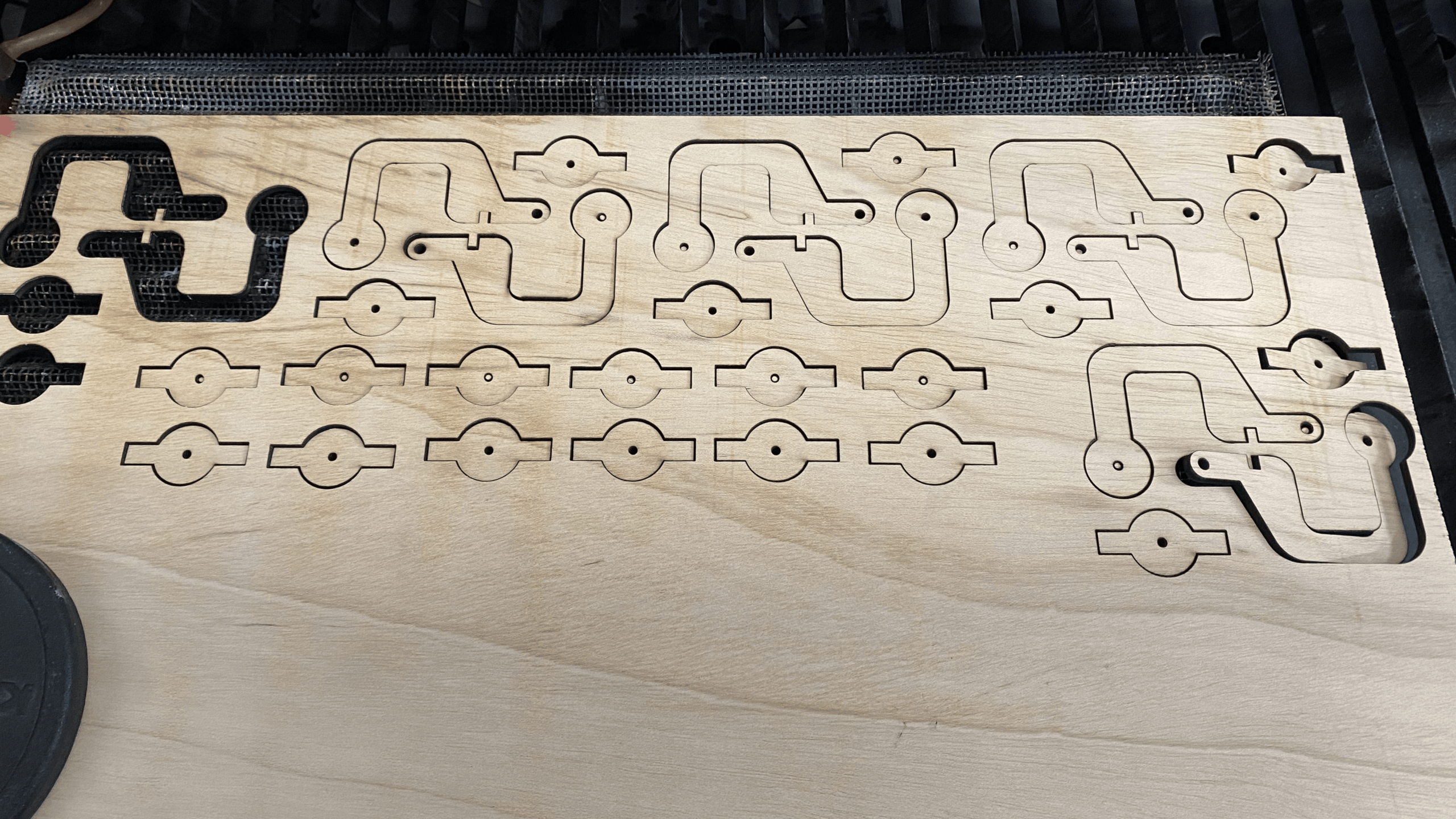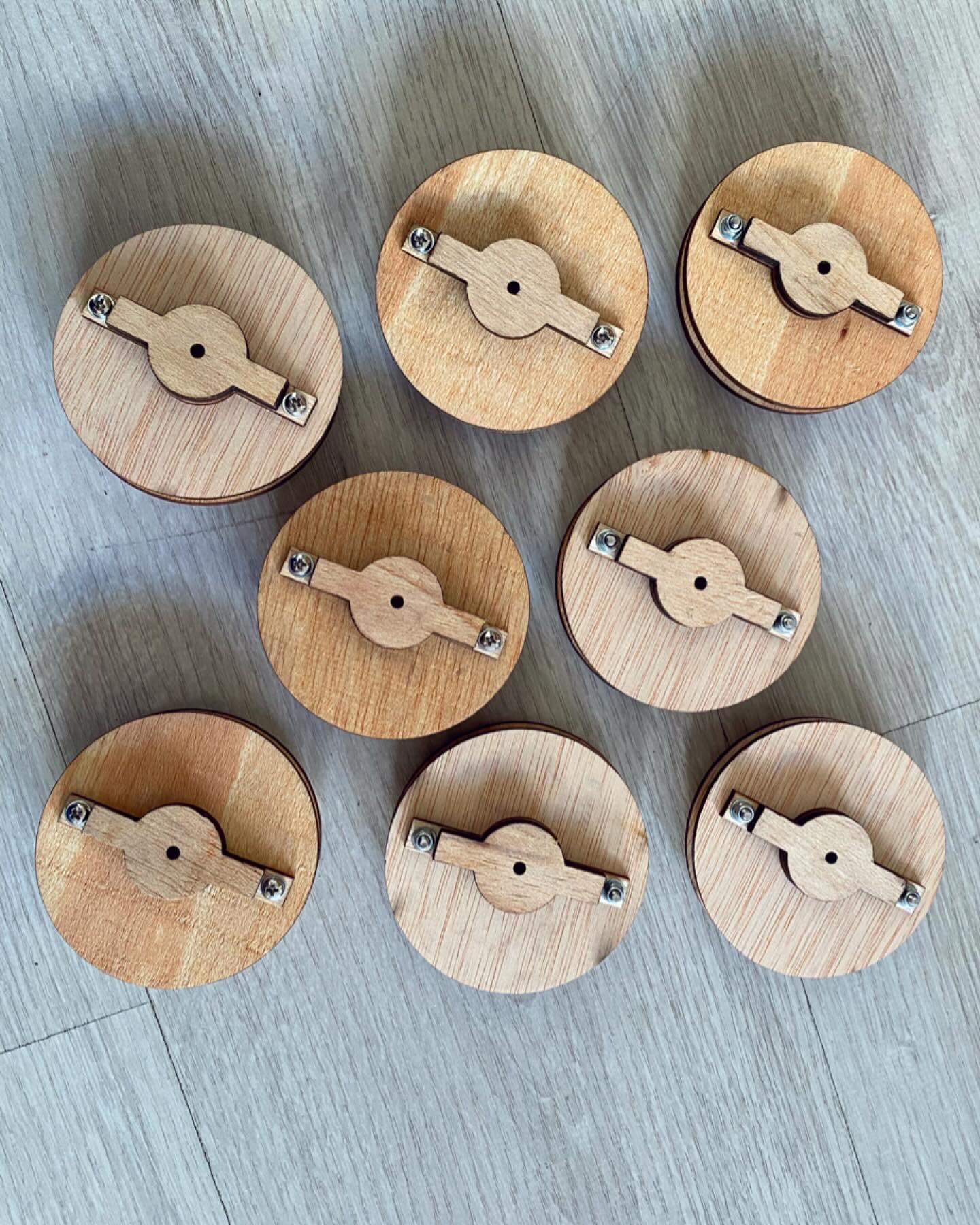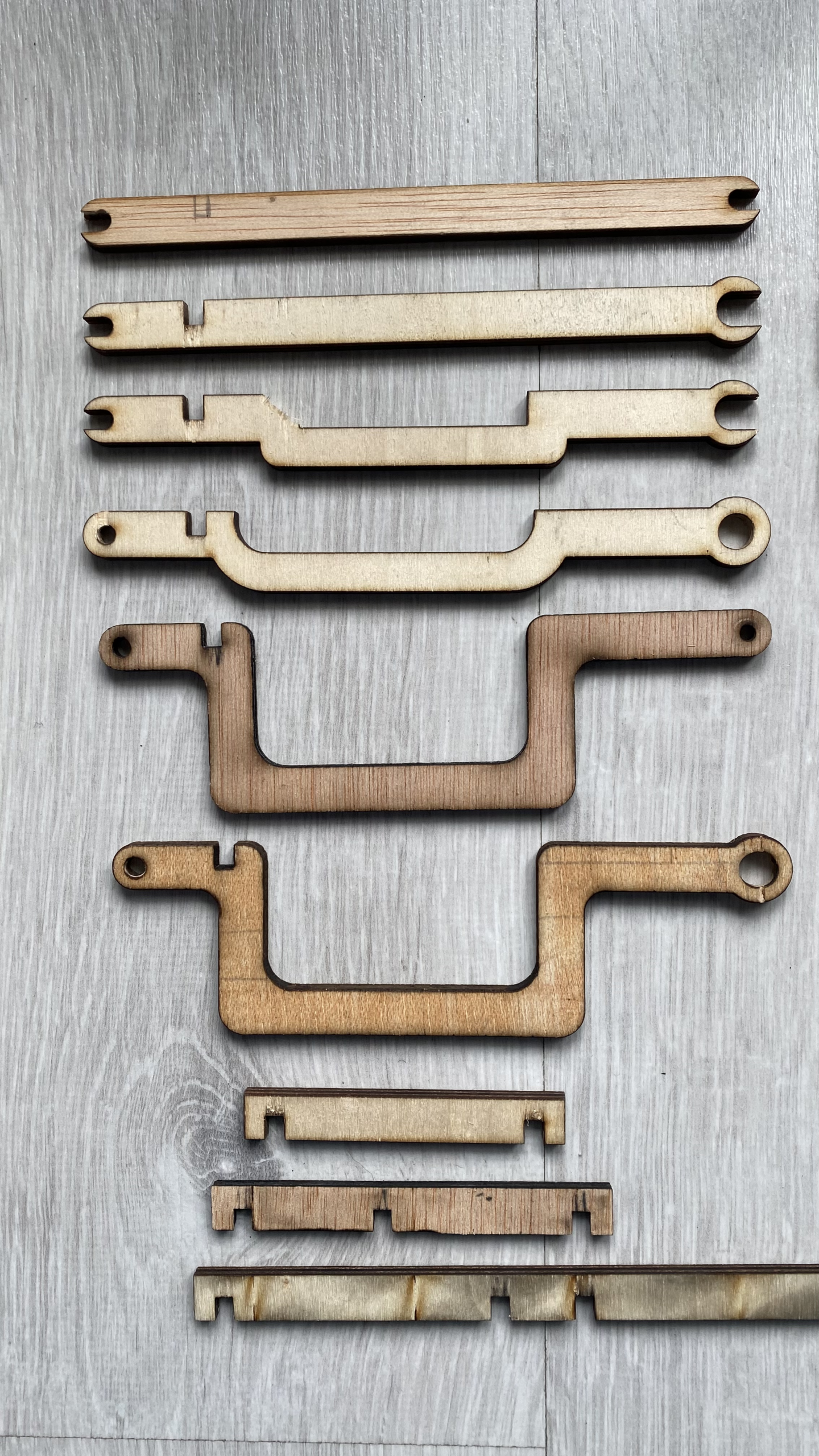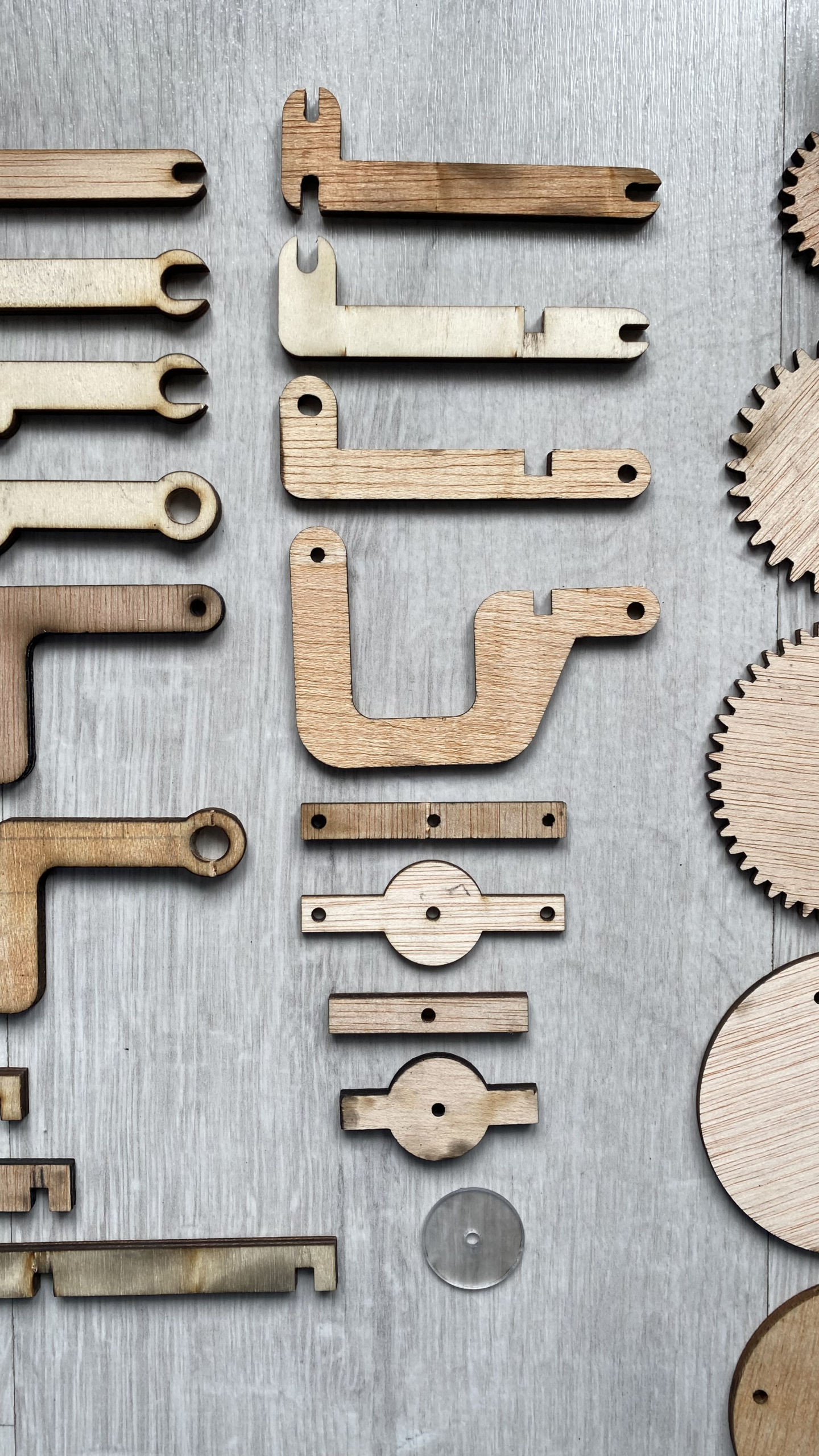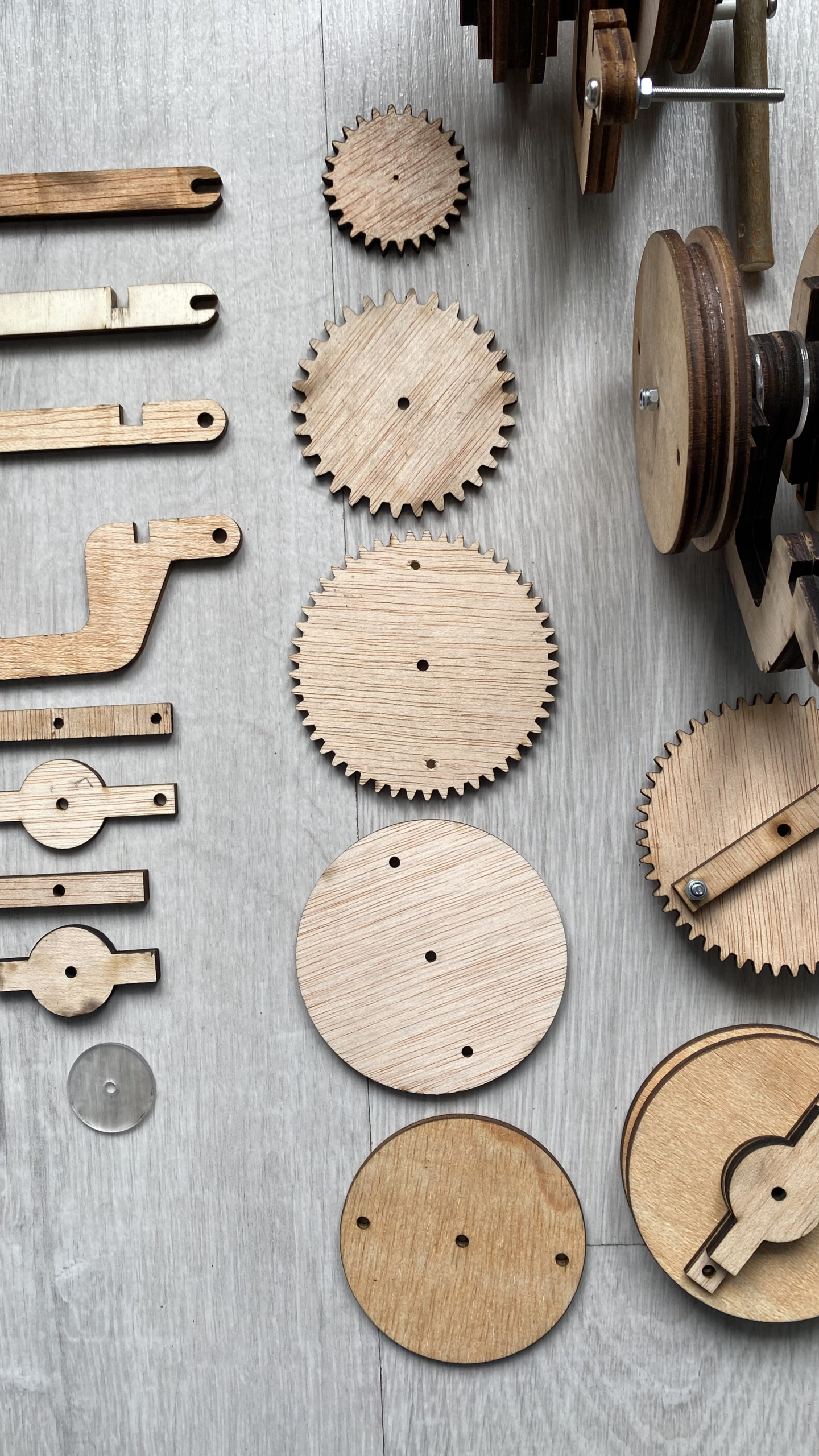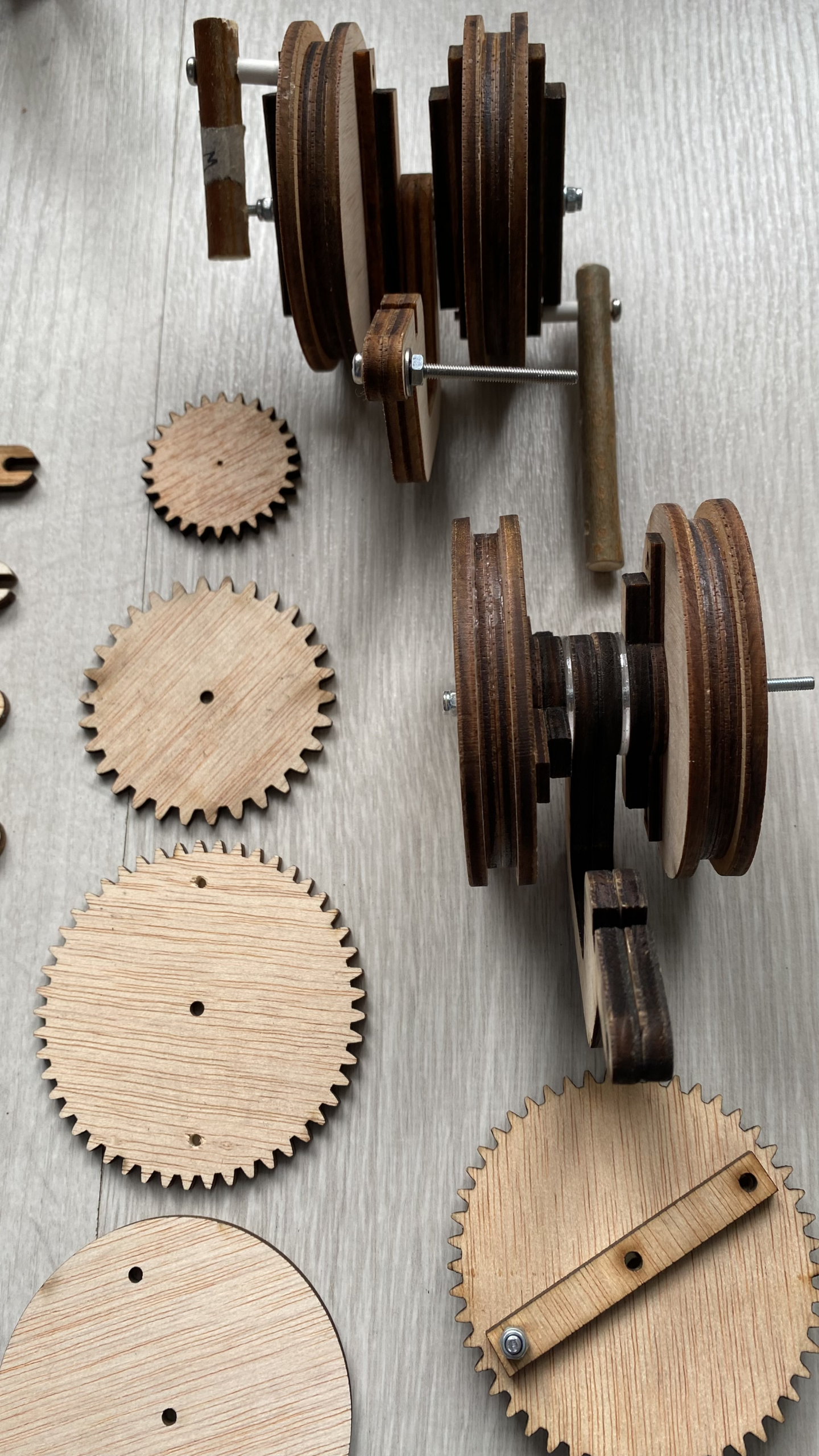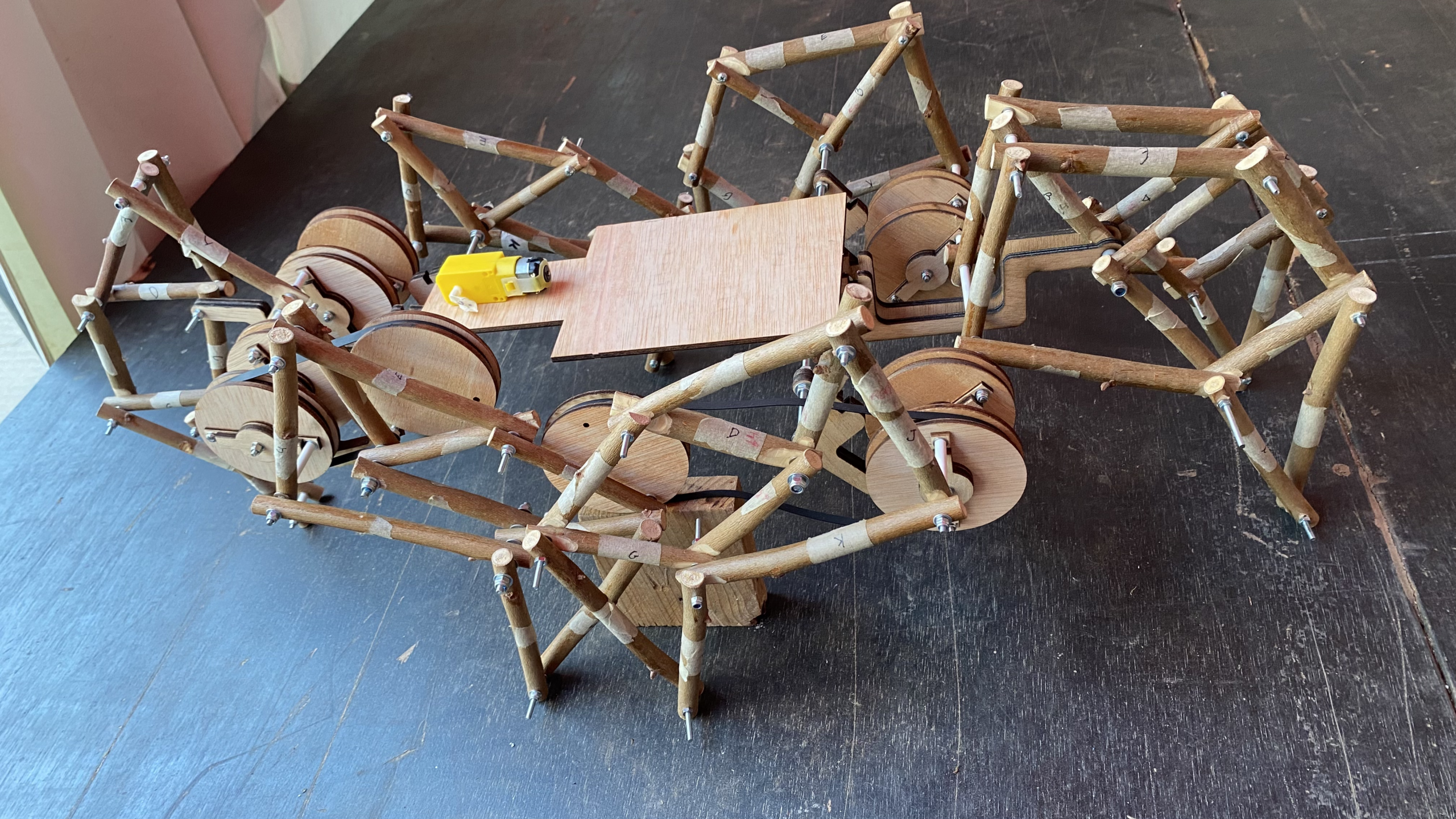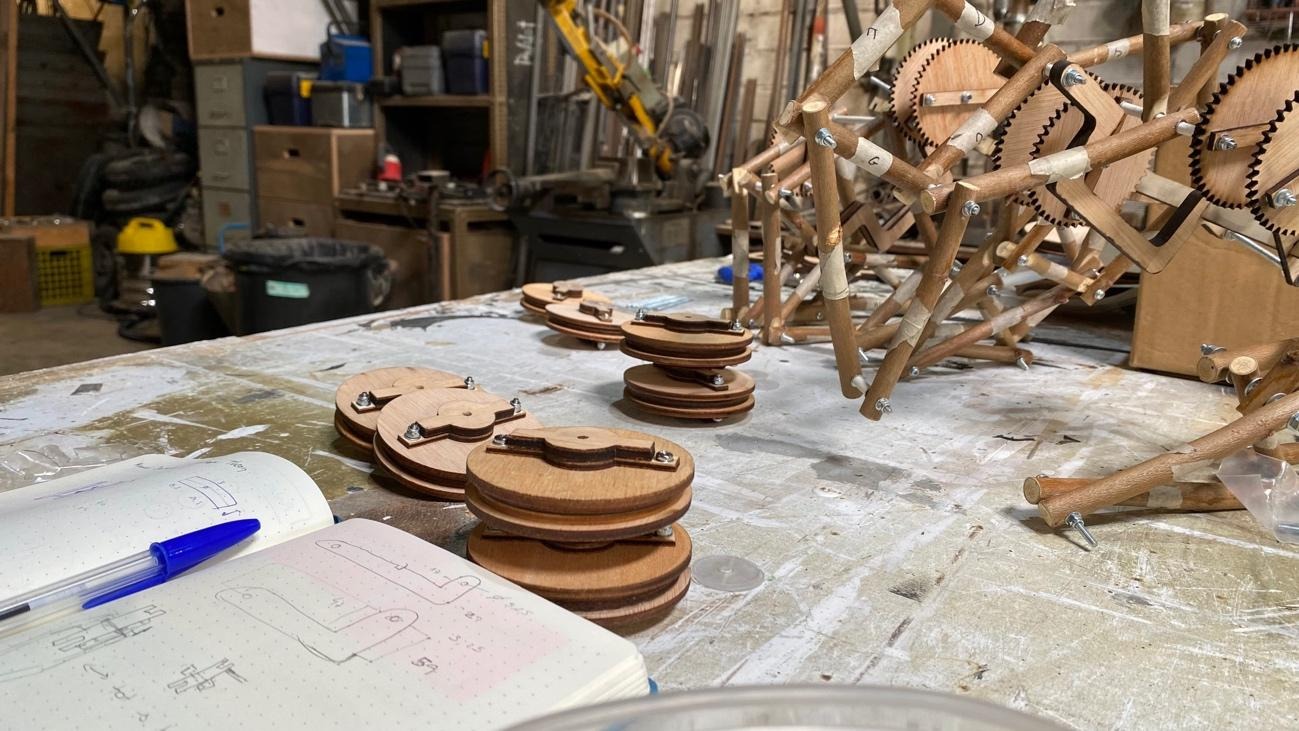

In September 2023, the second stage of building the transmission system began and proved to be the longest and most difficult. Marc Bassó, the technologist who had assisted me up to that point, relocated to another AdF, and I began working with Marianna Carenini and Diego Quilez, the industrial designer who replaced Marc Bassó. For several weeks, I attempted to find other companies that could provide toothed belts without success, and explored possible alternatives using different materials, such as fabric or rubber belts. However, after a brainstorming session with Diego, I finally decided to switch from a gear system to a pulley system because it seemed more feasible to find a transmission belt that would be more adaptable to the design. I designed custom pulleys using Onshape and made them from plywood. Before assembling all the pieces, I searched for rubber belts that would fit my design and were readily available in case they broke. I did not want to move on with the pulley system until I was sure I had all the necessary components to make it work. Finding the appropriate belts took over a month. The regular paper store rubbers were not long enough, but I found a feasible alternative in turntable belts, and a local store that could provide the different sizes I needed.
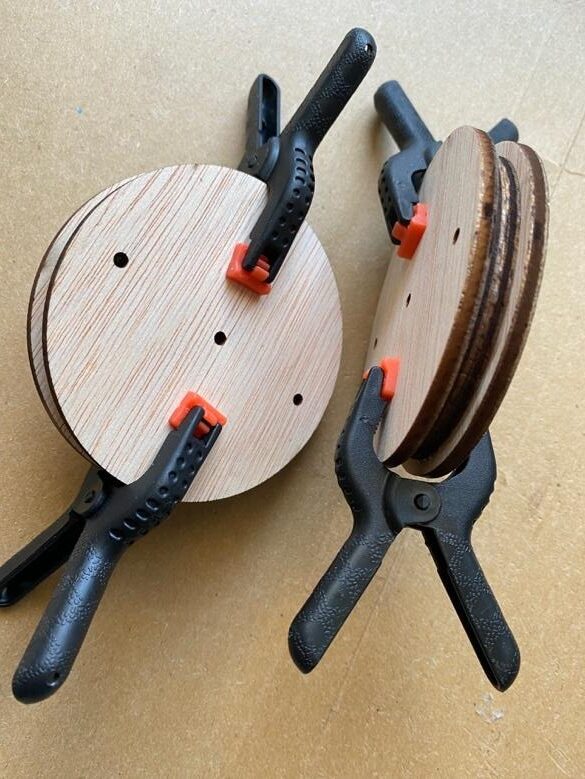
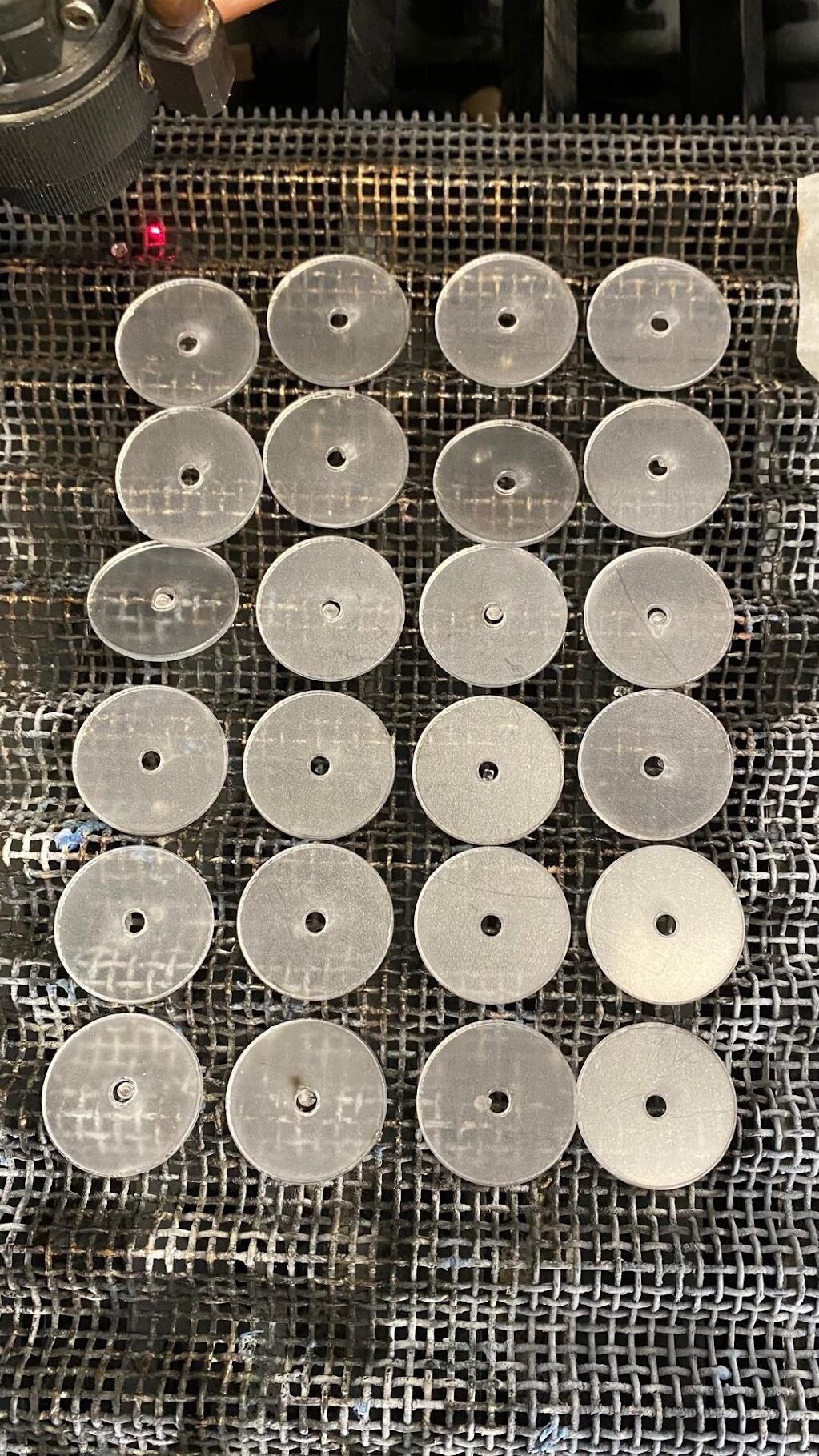
By the end of December 2023, I started modifying the width of the inner lane of the pulleys to fit the size of the turntable belts. I used plywood boards of different thicknesses and glued them together to achieve the proper dimensions. I also had to modify the inner support structure that kept the pairs of legs together to fit this new design, as the pulleys were heavier than the gears, and to minimise lateral deviations of the pulleys while turning. I also made custom washers from a sheet of polystyrene I had purchased for another project, because the standard washers I found did not fit the pulley structure perfectly and contributed to the deviations. I initially had some resistance to using plastics for this project. Still, I had to make some concessions because it was impossible to design every single piece from scratch and 3D print them with a biomaterial or make them out of wood.
I made significant progress for a couple of months, but around March 2024, the AdF Fàbrica del Sol underwent a public tender process that turned out to be very complicated. The facility was supposed to be closed for a couple of weeks, but it did not open again until almost July 2024. The entire team of technologists was relocated, and the users were not provided an alternative within the AdF network to continue their projects. I continued assembling pieces at home, and Jaume Baliarda, from L’Avalot Teatre, also gave me some space to work in the company’s workshop.
By May 2024, it was clear that the AdF Fàbrica del Sol would not open anytime soon. I contacted a couple of AdFs to explain the situation and book a session to use the laser cutter to cut all the pieces I needed, plus some spare ones as backups in case any broke, either during handling or due to wear and tear. I was finally able to book a session at the AdF Ciutat Meridiana. As compensation for using the facility, they suggested exhibiting my project at FestiXaf, which was held on June 27th 2024, at the AdF Gràcia. FestiXaf is an annual festival initiated by the AdFs network in 2023 to showcase the most interesting projects by its users. It also hosts conferences and roundtables to discuss the interactions, improvements, and new possibilities between digital manufacturing and the various stakeholders who use the network. During the FestiXaf, I was introduced to the AdF Les Corts team. I was suggested to continue the project there because they were the ones who could help me with the mechanisation and coding of Keré.